

Research profile of the applicant university
Central Node
Friedrich Schiller University Jena
Interdisciplinary research university linking fundamental science with translational and data-driven approaches
Core Strategic Focus
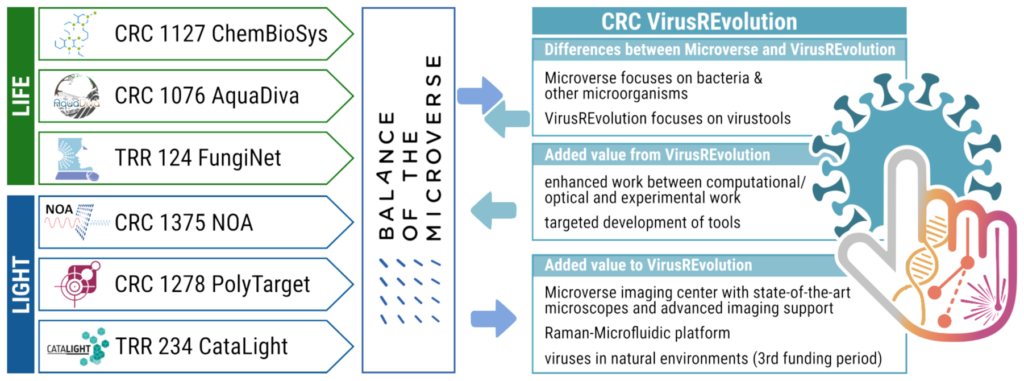
CRC VirusREvolution
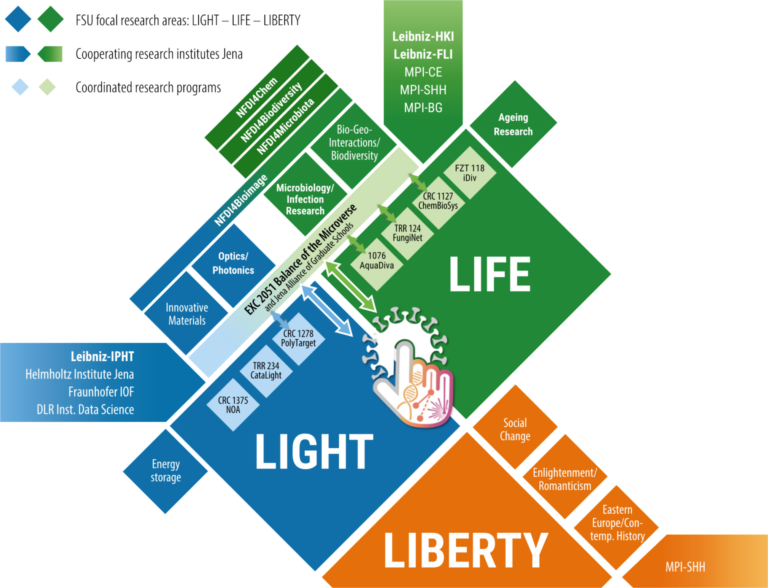
- Integrating virology, bioinformatics, and photonics at the interface of the LIFE and LIGHT profile areas
- Strengthening the connection between life sciences, data science, and optical technologies
Profile Areas (Foundational Layer)
LIFE – Life Sciences
Microbiology · Biodiversity · Bio-geo-interactions · Ageing Research
LIGHT – Optics & Photonics
Optics · Photonics · Innovative Materials · Advanced Technologies
LIBERTY – Social Sciences & Humanities
Social Transformation · Enlightenment · Romanticism · Contemporary History
Collaborative Research Centres (DFG-funded)
- CRC 1076 – AquaDiva Linking biodiversity research with environmental sciences
- CRC 1127 – ChemBioSys Chemical biology of biological systems
- CRC 1278 – PolyTarget Polymeric targeting strategies in medicine
- CRC 1375 – NOA Nonlinear optics and advanced photonic concepts
- CRC/TR 124 – FungiNet Fungal interactions and networks
- TRR 234 – CataLight Light-driven catalysis and photochemical processes
Research Units
- FOR 2179 – MAD Soil Microbial community dynamics in soils
- FOR 2518 – DynIon Dynamic ion transport in biological systems
- FOR 3004 – SYNABS Synthetic and analytical approaches to biological systems
Non-University Research Partners
- Leibniz Institute of Photonic Technology (IPHT)
- Leibniz Institute for Natural Product Research and Infection Biology – Hans Knöll Institute (HKI)
- Fraunhofer Institute for Applied Optics and Precision Engineering (IOF)
- Leibniz Institute on Aging – Fritz Lipmann Institute (FLI)
- Friedrich Loeffler Institute (FLI)
- Robert Koch Institute (RKI)
Supporting Research Ecosystem in Jena
- InfectoGnostics
- InfectControl
- InfectoOptics
- Max Planck Institute for Biochemistry
- Max Planck Institute for Geoanthropology
- Max Planck Institute for Chemical Ecology
- German Aerospace Center (DLR)
- CEMSIS
- Helmholtz Institute Jena
- Leibniz Centre for Photonics in Infection Research (LZP)
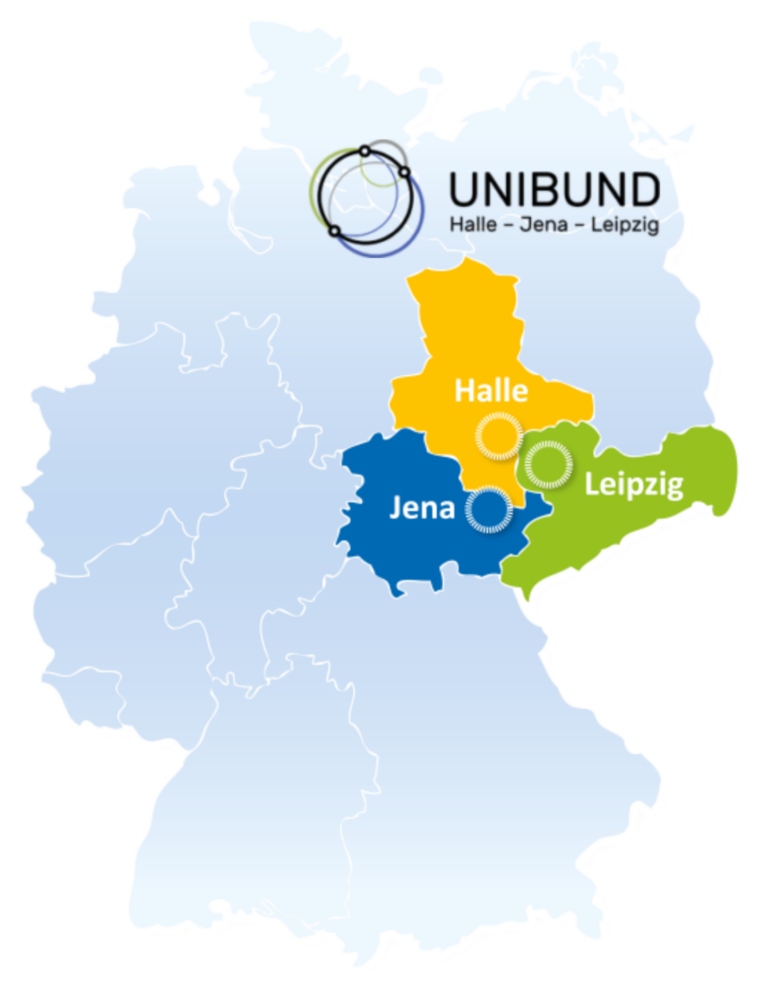
The University Alliance Halle-Jena-Leipzig, est. 1995
Long-Term Research Continuity
- Sustainable integration of basic and applied research
- Strong data, infrastructure, and technology sharing
- Long-standing collaborative structures supporting future innovation
Participation in NFDI Consortia
As part of its long-term commitment to data-driven research and open science, FSU Jena actively contributes to several consortia within the National Research Data Infrastructure (NFDI) initiative. These activities support the university’s strategic goal of embedding FAIR data principles, promoting interoperability, and establishing sustainable digital research infrastructures across disciplines.
Principal investigators of CRC VirusREvolution hold leading roles in multiple NFDI consortia:
-
NFDI4Microbiota – N. Cassman (Z02) and M. Marz (A04) contribute through the development of the virus database VirJenDB.
-
NFDI4Bioimage – T. Figge (C03) supports standardized, image-based data workflows.
-
NFDI4Biodiversity – B. König-Ries (Z02) contributes to biodiversity and ecological data integration.
-
NFDI4Chem – Multiple FSU Jena researchers participate in this consortium, coordinated by C. Steinbeck (FSU Jena), which develops tools and standards for chemical and metabolomics data.
Through these engagements, FSU Jena strengthens its role in national data infrastructures and ensures that CRC VirusREvolution is embedded in sustainable, interoperable research data ecosystems.
Infrastructure and Digital Innovation
Infrastructure development and digital innovation form a central pillar of FSU Jena’s strategic planning. Targeted investments strengthen the interface between basic research and clinical or translational applications.
The Center for Translational Medicine (CeTraMed) and the ThIMEDOP Innovation Centre exemplify this approach. These facilities integrate photonic, biomedical, and clinical expertise to enable a seamless pipeline from discovery to application in diagnostics, therapy, and prevention. They closely link technological excellence in optics and photonics with the clinical strengths of Jena University Hospital, particularly in infection and ageing research. Two CRC VirusREvolution PIs—C. Eggeling (C01, C03) and J. Popp (C04)—are directly involved in the EFRE-funded ThIMEDOP project, ensuring strong alignment between methodological innovation and clinical implementation.
The SEPTomics platform provides integrated multiomics capabilities, including proteomics, metabolomics, and lipidomics, supporting experimental and translational research. Several CRC VirusREvolution PIs make extensive use of SEPTomics for virus and microbiome studies, enabling comprehensive molecular profiling.
Complementing these translational facilities, the Abbe Center of Photonics (ACP) serves as a central academic hub for optics and photonics research. Through close cooperation with the Fraunhofer Institute for Applied Optics and Precision Engineering, the Helmholtz Institute Jena, and the Leibniz Institute of Photonic Technology, ACP provides access to state-of-the-art photonic platforms. Four CRC VirusREvolution PIs are leading members of ACP, ensuring that photonic tool development remains tightly integrated into FSU Jena’s long-term innovation strategy.
The Jena Center for Soft Matter (JCSM) offers an interdisciplinary environment linking chemistry, biology, physics, and materials science. Its activities foster the translation of molecular and nanoscale principles into biological and biomedical applications. Eight CRC VirusREvolution PIs are members of JCSM, underlining the strategic relevance of material-based and structural approaches for life science innovation.
The Jena Center for Bioinformatics (JCB) is FSU Jena’s key platform for computational biology and systems bioinformatics. It connects theoretical and experimental research across medicine, biology, and biotechnology and promotes algorithmic, data-driven approaches. Six CRC VirusREvolution PIs are active members of JCB, directly linking the CRC’s bioinformatics research to the university’s digital transformation strategy.
FSU Jena’s Bioinformatics Core Facility (BiC) provides centralized support for computational analysis, research data management, and high-performance computing across the life sciences. The facility enables reproducible workflows, seamless integration of experimental and multiomics data, and comprehensive training. Several CRC VirusREvolution PIs regularly use and contribute to BiC services, ensuring close alignment between computational infrastructure and CRC research goals.
At the European level, the APPEAL initiative (Antivirus Pandemic Preparedness EuropeAn pLatform)—coordinated at Jena University Hospital—provides a framework for antiviral drug discovery and pandemic preparedness. APPEAL integrates computational modelling, high-throughput screening, advanced 3D human-relevant models, animal studies, and pilot clinical validation.
Digital infrastructure and open-science activities are coordinated through DigLeben, which establishes sustainable digitalisation structures in the life sciences, and FDM Thüringen, coordinated by CRC PI R. Gerlach (Z02), which provides state-wide research data management support. Together, these initiatives ensure compliance with FAIR data principles and embed digital innovation deeply into FSU Jena’s institutional planning.
Within this context, the Michael Stifel Center Jena (MSCJ)—with CRC PI B. König-Ries (Z02) as spokesperson—plays a key role in establishing data science and computational modelling as strategic pillars of interdisciplinary research at FSU Jena.
A particularly relevant initiative for CRC VirusREvolution is DiaMETA-net, a German network founded by institutions including the RKI, FLI, and FSU Jena. DiaMETA-net brings together interdisciplinary research groups working in infectious medicine and diagnostic workflows based on next-generation sequencing. By combining complementary expertise in untargeted metagenomic analyses, the network enables the detection and taxonomic assignment of known and novel pathogens. Founding members include CRC PIs M. Marz (A04) and M. Beer (C04).
European Virus Bioinformatics Center (EVBC)
The European Virus Bioinformatics Center (EVBC) is a key strategic partner for CRC VirusREvolution. Founded and coordinated at FSU Jena in 2017 by CRC PI M. Marz (A04), the EVBC brings together more than 350 researchers from over 200 institutions worldwide.
The EVBC serves as an international networking and knowledge-exchange hub for virologists and bioinformaticians, fostering tool development, data integration, and the standardisation of analytical workflows in virus research. Established explicitly as a preparatory structure for a comprehensive collaborative research framework, the EVBC laid the conceptual and organisational foundation for CRC VirusREvolution by connecting key European partners and aligning research priorities in virus bioinformatics.