

All PIs have access to state-of-the-art facilities available for themselves and their coworkers. At the FSU, most research activities within the CRC VirusREvolution will be carried out in the Faculties of Mathematics and Computer Science, Biological Sciences, and Physics and Astronomy. The CRC VirusREvolution can fully rely on the resources of these faculties. Thus, most analytical instrumentation required for the planned work of the CRC is already available at FSU laboratories. In addition, FSU/University Hospital Jena (UKJ) provides certified biosafety level-2 (BSL-2) and BSL-3 laboratory facilities, ensuring that experimental work with pathogenic and high-risk viruses can be conducted safely and in full compliance with national biosafety regulations. These laboratories are accessible to CRC VirusREvolution researchers and constitute an essential foundation for the virological components of the planned research.
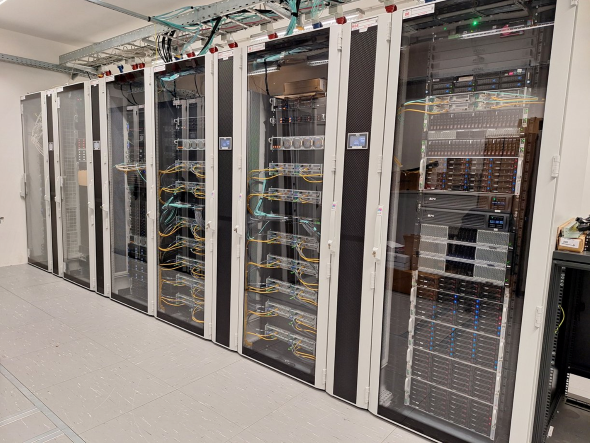
HPC cluster DRACO at FSU Jena
Selected important facilities include (For a full list f instrumentation):
- An high-performance computing (HPC) cluster with hundreds of Broadwell and SkyLake nodes and Omnipath connection (ARA)
- The second HPC cluster with ~ 130 compute nodes with ~ 6200 CPU cores, 35 NVIDIA A100 GPUs for ML, and 700 TB fast storage (DRACO)
- The newly, third approved HPC cluster will provide ~ 90 compute nodes and 1.5 PB fast storage (ARA2)
- A fully equipped nuclear magnetic resonance (NMR) facility with several high field (up to 800 MHz) instruments
- High-resolution liquid chromatography-mass spectrometry (LC-MS) and gas chromatographymass spectrometry (GC-MS) equipment for metabolomics, structure elucidation, and metabolic flux analyses
- LC-MS facility for proteomic analysis
- Numerous MS instruments
- Microverse Imaging Center, with state-of-the-art microscopes – from basic fluorescence and Raman microscopes to lightsheet and all versions of super-resolution (STED, STORM/PALM, SIM, MINFLUX) microscopes
- Diverse imaging platforms (imaging ATM-MS, MALDI, Raman-based techniques)
- Raman-microfluidic platform
- X-ray and Electron Microscopy facility
- Elaborate climate chambers and greenhouses
- FACS sorter
- Mechanical, electrical, electronics, and glass blower workshops
With unique equipment in the field of Raman spectroscopy and fluorescence microscopy, the Leibniz IPHT, as a cooperation partner, provides important research infrastructure to the CRC VirusREvolution. This includes a broad variety of advanced and modern turn-key Raman and fluorescence microscopes and spectrometers. In addition, the Leibniz IPHT has the complete technology chain for the fabrication and characterisation of optical fibres and a cleanroom facility for production of surface structures as useful tools for tailored analytical approaches.
The FSU will support the installation of a novel high-resolution LC-MS that will be a major platform instrument for the metabolomics activities in CRC VirusREvolution.
In addition, FSU/University Hospital Jena (UKJ), JLU Giessen, WWU Münster, and the University of Leipzig provide certified BSL-2 and BSL-3 laboratory facilities, while the FLI Greifswald additionally operates BSL-4 laboratories. This infrastructure ensures that experimental work with pathogenic and high-risk viruses can be conducted safely and in full compliance with national biosafety regulations.
Research data management.
Z02: INFormation, INFormatics, and INFrastructure
CRC VirusREvolution is a highly interdisciplinary initiative that will generate large volumes of diverse and complex data. Effective management of data acquisition, storage, analysis, and visualisation, therefore, requires both a service-oriented and research-oriented approach. This will be ensured by the designated information infrastructure project Z02 (Barth/Cassman/Gerlach/König-Ries), which will coordinate and implement research data management (RDM) across the CRC and provide scientific services to all subprojects. Its activities will range from the development of an overarching CRC data management strategy and project-specific data management plans to hands-on support for FAIR data provision, data publication, and software sustainability. In addition, Z02 (Barth/Cassman/Gerlach/König-Ries) will provide access to dedicated data management platforms (including VirJenDB and OMERO) and bioinformatics services.
Beyond supporting the CRC’s research activities, Z02 will play a central role in ensuring that all data and software products generated within the CRC remain accessible and reusable beyond the lifetime of the initiative, in line with the FAIR principles and the “DFG Leitlinien zum Umgang mit Forschungsdaten (2015)”. By connecting to relevant consortia of the National Research Data Infrastructure (NFDI) – notably NFDI4Microbiota, NFDI4Chem, NFDI4Bioimage, and NFDI4Biodiversity, see Sec. A.6 – the project will enable data interoperability across domains and foster collaborations within and beyond the CRC community. An integral part of the project is the training of CRC researchers in best practices of RDM, data stewardship, and reproducible research.
Z02 builds on strong institutional infrastructures and commitments at the FSU Jena. These include services provided by the University Computing Center (URZ), the Thuringian University IT Center (HS-ITZ), and the Thuringian University and State Library (ThULB), as well as bioinformatics expertise and high-performance computing resources provided by the Bioinformatics Core Facility (BiC). The principal investigators of Z02 maintain close operational links to these infrastructures: B. König-Ries (Z02), M. Marz (A04), and N. Cassman (Z02) are actively involved in NFDI4Biodiversity and NFDI4Microbiota, respectively, R. Gerlach (Z02) heads the university’s Research Data Management Helpdesk and coordinates the Thuringian Competence Network RDM; E. Barth (Z02) heads BiC. These connections ensure seamless access to institutional and national infrastructures and guarantee the long-term sustainability of CRC data assets. The CRC will also actively contribute to shaping the evolving RDM landscape at Uni Jena. Through the establishment of integrated workflows, data policies, and training modules, the CRC will serve as a model for interdisciplinary RDM within the university. The CRC’s Data Policy, aligned with the Uni Jena Guideline on Research Data Management and national recommendations, will be developed in the first year. In close coordination with the Cluster of Excellence “Balance of the Microverse”, which addresses related challenges in managing large, heterogeneous data sets (e.g. from high-resolution imaging and multi-omics analyses), the CRC will promote shared standards and interoperable solutions across research domains. By fostering a culture of openness, standardisation, and data sharing, the CRC will strengthen institutional RDM capacities and contribute to Uni Jena’s strategic goals in digital research infrastructure and sustainable data management.
Ecological sustainability.
The CRC’s ecological measures are aligned with the Sustainability Strategy of FSU Jena, which commits to resourceefficient, climate-aware research practices and reductions in emissions across research, mobility, procurement, and digital infrastructure. The Green Office – the University’s central hub for sustainability – provides guidance, coordination, and awareness activities and serves as a point of contact for implementing sustainable practices within CRC structures. In accordance with the FSU Travel Handbook, CRC members prioritise train wherever feasible. The University encourages all staff to critically assess the necessity of flights and make use of the CO2-compensation options, thereby contributing to the university-wide effort to lower emissions from business travel. The CRC adheres to the University’s sustainability standards for procurement and laboratory practice, emphasising reduced material consumption and the selection of environmentally certified products, (e.g. Blue Angel, PEFC, EMAS), recyclable or low-impact materials, and energy-efficient devices.
B04: Linking macroscopic evolution with molecular processes for rapidly evolving viral pathogens
Importantly, within our CRC VirusREvolution, sustainability is not simply a formal commitment, but instead is reflected in the concrete design of the CRC’s research programme. Three examples illustrate this: (1) To minimise the generation of new material, the CRC builds on existing resources whenever possible. For instance, A02 (Friedel/ Kühnert) relies on available virus sequence data (e.g. SARS-CoV-2), consistent with the University’s aim to promote resource-efficient research and responsible data use. (2) Only limited equipment purchases are planned where it is really necessary: small equipment in B02 (Jordan/Stadler) and Z03 (Fröhlich/Höppener/Reiche), a laser and a camera in C03 (Eggeling/Figge/Schelhaas), and a 3D printer in Z04 (Fabisch/Marz). (3) In B04 (Dittrich/McHardy), dedicated computing hardware will be purchased instead of relying on cloud-based solutions, as local systems offer a more sustainable long-term option and can be reused in future funding periods. In contrast, Z02 (Barth/Cassman/Gerlach/ König-Ries) will not acquire new computing infrastructure; instead, the project will make use of existing facilities at the University and purchase only the small add-on components required to carry out the planned work. (4) in general, use of large equipment of any kind from sample preparation to spectroscopic and microscopy equipment will be shared, as highlighted through the centralisation in facilities.
Strong institutional commitment of FSU Jena to the CRC VirusREvolution.
The Friedrich Schiller University Jena is deeply committed to the success of the CRC VirusREvolution, seeing it as a flagship initiative that perfectly embodies the university’s vision for cutting-edge, interdisciplinary research within its profile areas LIGHT, LIFE, LIBERTY. This commitment is not symbolic, but active, substantial, and strategically anchored. The university is genuinely excited about the momentum that the CRC will create and is fully prepared to empower it with the structures, resources, and institutional backing needed to let this consortium flourish. FSU Jena recognises the CRC as a unique opportunity to unite virology, computational biology, photonics, analytical chemistry, and imaging at an unprecedented level, and it will work proactively to ensure that the CRC becomes an internationally visible centre of excellence. In this spirit, the university enthusiastically contributes a broad set of support measures that will strengthen collaboration, foster talent, and provide the optimal environment for the CRC’s scientific breakthroughs.
General commitments of the FSU Jena:
- Basic institutional equipment / baseline infrastructure
- Laboratory and office space
- Comprehensive early-career support across all qualification levels
- Active engagement of the Vice-President for Universities Community and Engagement
- Targeted faculty appointments aligned with future CRC needs
- Full integration into the Graduate Academy infrastructure, supporting Z05 (Eggeling/Hoffmann/Jordan)
- Professional support via Communications and Marketing, supporting Z04 (Fabisch/Marz)
CRC-specific commitments:
- Continued funding of the junior research group P. Jordan (B02) “Innate Immune Signalling Pharmacology”
- Creation of junior research group “ML Data Integration from Photonics to Genomics”
- Provision of 16 additional student assistant positions
- Free usage of the core Microscopy Imaging Center Jena
- Dedicated compute nodes for sensitive CRC data
- Free access to DRACO and ARA HPC clusters, with supplement funds requested in Z02 (Barth/Cassman/Gerlach/König-Ries)
- Support of € 4 000 per PI per year.