


Central Tasks of the Collaborative Research Centre
Central tasks. The tasks in the central project Z01 of the CRC VirusREvolution are (1) the management of the CRC with regard to governance, project funds, reporting, staff, travel, and guest scientists; (2) the close collaboration with the other Z-projects Z02, Z03, Z04, and Z05, to support data management and synergy, international visibility and science communication, and the promotion of early career researchers, respectively; (3) the implementation of measures to promote equal opportunities, diversity, and sustainability; (4) the representation and communication of the CRC towards the DFG, partner institutions, and FSU Jena; and (5) the organisation of the scientific VirusREvolution events, such as meetings, symposia, retreats, and workshops, to foster internal communication and strong interactions.
Governance of CRC VirusREvolution. The governance of the CRC is formed by a managing board, Fig. Z01.1, comprising the spokesperson M. Marz (A04) and the four co-spokespersons, of which F. Weber (A03), S. Böcker (B01), and C. Eggeling (C01, C03) represent the three focal areas, and S. Deinhardt-Emmer (C02) our main local virologist and Gender Equality Officer. The board meets twice a year to evaluate the project progress and to plan scientific meetings. It is responsible for devising and implementing measures to promote the CRC towards its scientific objectives.
A scientific coordinator and an administrative assistant (10 h/week) will support the managing board and the central project Z01 with the administrative coordination and organisation of the general tasks (1) to (4). Additionally, the scientific coordinator will take on task (5), which is central to our CRC’s uniquely designed tandem-PI project structure and its three-layer concept described in Research strategy and structure of the CRC.
The CRC will establish an external Scientific Advisory Board (SAB) that will convene once per year at the annual retreat or bi-annually. The SAB will support the CRC managing board with strategic decisions, quality control, and adjustments towards novel developments within the field.
Internal communication and synergy. The heart of our CRC VirusREvolution is its three-layer communication structure, which makes our CRC unique, see Research strategy and structure of the CRC.
By connecting researchers (a) within tandem projects, (b) across the three project areas, and especially (c) our meetings around the overarching research questions to create a dynamic environment where ideas are expected to flow freely, expertise is integrated, and innovation is sparked.
Organising these meetings requires substantial effort from the scientific coordinator, who ensures that diverse methodological perspectives and research priorities are brought together effectively. These interactions serve as essential platforms for sharing progress, generating creative solutions to laboratory hypotheses, identifying new applications for our tools, and maintaining consistency in data interpretation and methodologies. Our targeted workshops are dedicated sessions that focus on one single, well-defined research question, see p. 37 and further strengthen collaboration by addressing shared challenges and stimulating novel approaches. This vibrant, structured internal communication is a cornerstone of our CRC and a key driver for achieving its long-term scientific ambitions. These interactions will make our CRC VirusREvolution truely special.
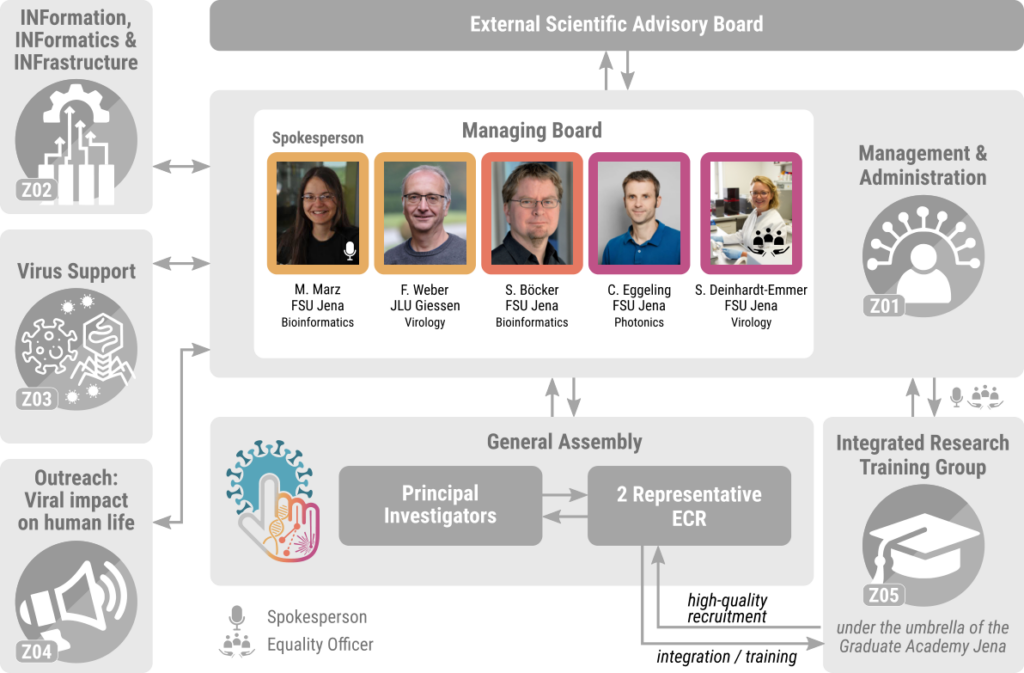
The internal structure of the CRC VirusREvolution.
Team Members




N. N.
Scientific Coordinator
N. N.
Administrative Assistance