


Linking macroscopic evolution with molecular processes for rapidly evolving viral pathogens
Viral pathogens such as SARS-CoV-2 and human influenza A viruses are single-stranded RNA viruses with substantial capacity to mutate and to adapt to the human host for more efficient replication and spread. A multitude of factors affect the evolutionary patterns left in their genomes, such as adaptation to changing host immunity or for more efficient replication, phylogenetic spread, as well as uncharacterised processes on the cellular level. Continuous changes in the surface antigens of these viruses allow them to evade host immunity developed through either prior infection from previous strains or from vaccination. This capacity of a virus, known as immune escape, facilitates the reinfection of individuals. Consequently, vaccines protecting against such viruses need to be frequently updated to maintain their effectiveness against circulating variants. We hypothesise that our understanding of the complex interplay of these various processes from large-scale viral genome data can be improved by careful analysis and deconvolution with tailor-made computational techniques. This improved understanding of viral evolution will make it even more predictable on the population level and facilitate the early identification of future emerging, antigenically altered variants of concern for public health.
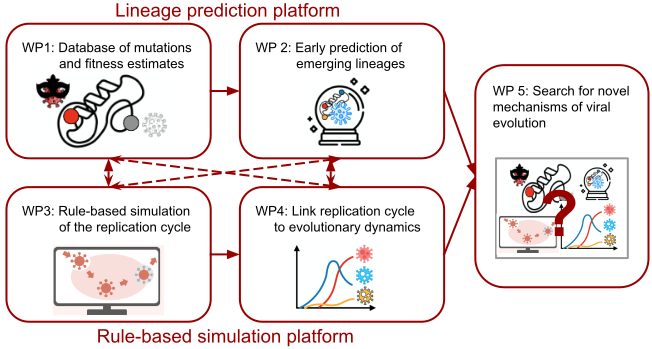
We have recently developed techniques that allowed us to predict the emergence of relevant variants of SARS-CoV-2, as reported by the World Health Organization (WHO), substantially prior to this classification and to their reaching their maximal abundances. We are also able to identify lineages with substantial antigenic alterations, which can inform considerations regarding vaccine strain updates. In this project, we will combine data-driven analytics of population level viral diversity with molecular modelling across scales to link macroscopic viral evolution on a population level to molecular processes within the cell. By combining data-driven surveillance and simulation, we will be able to study evolutionary and epidemiological phenomena in both data and models. These include: (1) Developing approaches for early detection and further characterisation of antigenically or otherwise phenotypically altered lineages identified by the WHO as Variants of Concern (VOCs) via viral genomic surveillance (G3). Early detection methods for identifying antigenically altered lineages classified by the World Health Organization as concerning, of interest, or under monitoring have recently been developed in the McHardy lab.
We will extend this approach to predict combinations of amino acid changes driving future predominant lineages, enabling earlier detection of potential VOCs than current methods. (2) Developing a multi-scale simulation platform consisting of (i) a micro-level – simulating virus replication within a cell; and (ii) a macro-level – simulating virus evolution. At the micro level, we will develop a new type of rule-based description language, including RNA and dynamical compartments. The rule-based replication cycle model will allow us to trace a mutation through the replication cycle. This trace helps to clarify the putative effects of the mutation on the dynamics of the replication cycle, and also to explain how the mutation could affect the fitness of the virus. (3) Combining the results from all work packages to disentangle the contributions of genetic drift, antigenic drift, and currently uncharacterised processes on the genetic diversity of circulating lineages and to study the evolutionary role of the “not-yet-explained” mutations that influence the replication cycle of the virus within the host cell.
- WP 1: Database of phenotype-altering and neutral mutations and amino acid changes in viral evolution (McHardy)
- WP 2: Early prediction of predominant, antigenically altered lineage types (McHardy)
- WP 3: Rule-based simulation platform of in-cell replication cycle (Dittrich)
- WP 4: Tools for sequence-level evolutionary and epidemiological dynamics (Dittrich)
- WP 5: Search for novel mechanisms of viral evolution (McHardy/Dittrich)
Team Members



N. N.
Postdoctoral Researcher
N. N.
Postdoctoral Researcher
Dr. Mohammad-Hadi Foroughmand-Araabi
Associated Postdoctoral Researcher
Project-Specific Publications
2025
Norwood, Katrina; Deng, Zhi-Luo; Reimering, Susanne; Robertson, Gary; Foroughmand-Araabi, Mohammad-Hadi; Goliaei, Sama; Hölzer, Martin; Klawonn, Frank; McHardy, Alice C
In silico genomic surveillance by CoVerage predicts and characterizes SARS-CoV-2 Variants of Interest Journal Article
In: Nat Commun, vol. 16, iss. 1, pp. 6281, 2025.
@article{Norwood:25,

title = {In silico genomic surveillance by CoVerage predicts and characterizes SARS-CoV-2 Variants of Interest},

author = {Katrina Norwood and Zhi-Luo Deng and Susanne Reimering and Gary Robertson and Mohammad-Hadi Foroughmand-Araabi and Sama Goliaei and Martin Hölzer and Frank Klawonn and Alice C McHardy},

url = {https://pubmed.ncbi.nlm.nih.gov/40628697/},

doi = {10.1038/s41467-025-60231-4},

year  = {2025},

date = {2025-07-01},

journal = {Nat Commun},

volume = {16},

issue = {1},

pages = {6281},

publisher = {Cold Spring Harbor Laboratory},

keywords = {},

pubstate = {epublish},

tppubtype = {article}

}
2024
Goliaei, Sama; Foroughmand-Araabi, Mohammad-Hadi; Roddy, Aideen; Weber, Ariane; Översti, Sanni; Kühnert, Denise; McHardy, Alice C
Importations of SARS-CoV-2 lineages decline after nonpharmaceutical interventions in phylogeographic analyses Journal Article
In: Nat Commun, vol. 15, no. 1, pp. 5267, 2024.
@article{Goliaei:24b,

title = {Importations of SARS-CoV-2 lineages decline after nonpharmaceutical interventions in phylogeographic analyses},

author = { Sama Goliaei and Mohammad-Hadi Foroughmand-Araabi and Aideen Roddy and Ariane Weber and Sanni Översti and Denise Kühnert and Alice C McHardy},

url = {https://www.nature.com/articles/s41467-024-48641-2},

doi = {https://doi.org/10.1038/s41467-024-48641-2},

year  = {2024},

date = {2024-06-01},

urldate = {2024-06-01},

journal = {Nat Commun},

volume = {15},

number = {1},

pages = {5267},

publisher = {Springer Science and Business Media LLC},

keywords = {},

pubstate = {published},

tppubtype = {article}

}
2021
Bankwitz, Dorothea; Bahai, Akash; Labuhn, Maurice; Doepke, Mandy; Ginkel, Corinne; Khera, Tanvi; Todt, Daniel; Ströh, Luisa J; Dold, Leona; Klein, Florian; Klawonn, Frank; Krey, Thomas; Behrendt, Patrick; Cornberg, Markus; McHardy, Alice C; Pietschmann, Thomas
Hepatitis C reference viruses highlight potent antibody responses and diverse viral functional interactions with neutralising antibodies. Journal Article
In: Gut, vol. 70, iss. 9, pp. 1734–1745, 2021.
@article{Bankwitz:21,

title = {Hepatitis C reference viruses highlight potent antibody responses and diverse viral functional interactions with neutralising antibodies.},

author = {Dorothea Bankwitz and Akash Bahai and Maurice Labuhn and Mandy Doepke and Corinne Ginkel and Tanvi Khera and Daniel Todt and Luisa J Ströh and Leona Dold and Florian Klein and Frank Klawonn and Thomas Krey and Patrick Behrendt and Markus Cornberg and Alice C McHardy and Thomas Pietschmann},

doi = {10.1136/gutjnl-2020-321190},

year  = {2021},

date = {2021-01-01},

journal = {Gut},

volume = {70},

issue = {9},

pages = {1734–1745},

keywords = {},

pubstate = {published},

tppubtype = {article}

}
Peter, Stephan; Ibrahim, Bashar; Dittrich, Peter
Linking network structure and dynamics to describe the set of persistent species in reaction diffusion systems Journal Article
In: SIAM J. Appl. Dyn. Syst., vol. 20, iss. 4, pp. 2037–2076, 2021.
@article{Peter:21,

title = {Linking network structure and dynamics to describe the set of persistent species in reaction diffusion systems},

author = {Stephan Peter and Bashar Ibrahim and Peter Dittrich},

doi = {10.1137/21m1396708},

year  = {2021},

date = {2021-01-01},

journal = {SIAM J. Appl. Dyn. Syst.},

volume = {20},

issue = {4},

pages = {2037–2076},

publisher = {Society for Industrial & Applied Mathematics (SIAM)},

keywords = {},

pubstate = {published},

tppubtype = {article}

}
2020
Peter, Stephan; Dittrich, Peter; Ibrahim, Bashar
Structure and hierarchy of SARS-CoV-2 infection dynamics models revealed by reaction network analysis Journal Article
In: Viruses, vol. 13, iss. 1, pp. 14, 2020.
@article{Peter:20,

title = {Structure and hierarchy of SARS-CoV-2 infection dynamics models revealed by reaction network analysis},

author = {Stephan Peter and Peter Dittrich and Bashar Ibrahim},

url = {https://pubmed.ncbi.nlm.nih.gov/33374824/},

doi = {10.3390/v13010014},

year  = {2020},

date = {2020-12-01},

journal = {Viruses},

volume = {13},

issue = {1},

pages = {14},

publisher = {MDPI AG},

keywords = {},

pubstate = {epublish},

tppubtype = {article}

}
2019
Peter, Stephan; Hölzer, Martin; Lamkiewicz, Kevin; Fenizio, Pietro Speroni; Hwaeer, Hassan Al; Marz, Manja; Schuster, Stefan; Dittrich, Peter; Ibrahim, Bashar
Structure and hierarchy of influenza virus models revealed by reaction network analysis. Journal Article
In: Viruses, vol. 11, iss. 5, 2019.
@article{Peter:19,

title = {Structure and hierarchy of influenza virus models revealed by reaction network analysis.},

author = {Stephan Peter and Martin Hölzer and Kevin Lamkiewicz and Pietro Speroni Fenizio and Hassan Al Hwaeer and Manja Marz and Stefan Schuster and Peter Dittrich and Bashar Ibrahim},

url = {https://pubmed.ncbi.nlm.nih.gov/31100972/},

doi = {10.3390/v11050449},

year  = {2019},

date = {2019-05-01},

journal = {Viruses},

volume = {11},

issue = {5},

keywords = {},

pubstate = {epublish},

tppubtype = {article}

}
Henze, Richard; Grünert, Gerd; Ibrahim, Bashar; Dittrich, Peter
Spatial rule-based simulations: The SRSim software. Journal Article
In: Methods Mol Biol, vol. 1945, pp. 231–249, 2019.
@article{Henze:19,

title = {Spatial rule-based simulations: The SRSim software.},

author = {Richard Henze and Gerd Grünert and Bashar Ibrahim and Peter Dittrich},

url = {https://pubmed.ncbi.nlm.nih.gov/30945249/},

doi = {10.1007/978-1-4939-9102-0_10},

year  = {2019},

date = {2019-01-01},

journal = {Methods Mol Biol},

volume = {1945},

pages = {231–249},

keywords = {},

pubstate = {ppublish},

tppubtype = {article}

}
2014
Steinbrück, Lars; Klingen, T R; McHardy, Alice C
Computational prediction of vaccine strains for human influenza A (H3N2) viruses. Journal Article
In: J Virol, vol. 88, iss. 20, pp. 12123–12132, 2014.
@article{Steinbrueck:14,

title = {Computational prediction of vaccine strains for human influenza A (H3N2) viruses.},

author = {Lars Steinbrück and T R Klingen and Alice C McHardy},

url = {https://pubmed.ncbi.nlm.nih.gov/25122778/},

doi = {10.1128/JVI.01861-14},

year  = {2014},

date = {2014-10-01},

journal = {J Virol},

volume = {88},

issue = {20},

pages = {12123–12132},

keywords = {},

pubstate = {ppublish},

tppubtype = {article}

}
2012
Steinbrück, Lars; McHardy, Alice Carolyn
Inference of genotype–phenotype relationships in the antigenic evolution of human influenza A (H3N2) viruses Journal Article
In: PLoS Comput Biol, vol. 8, iss. 4, pp. e1002492, 2012.
@article{Steinbrueck:12,

title = {Inference of genotype–phenotype relationships in the antigenic evolution of human influenza A (H3N2) viruses},

author = {Lars Steinbrück and Alice Carolyn McHardy},

doi = {10.1371/journal.pcbi.1002492},

year  = {2012},

date = {2012-01-01},

journal = {PLoS Comput Biol},

volume = {8},

issue = {4},

pages = {e1002492},

publisher = {Public Library of Science (PLoS)},

keywords = {},

pubstate = {published},

tppubtype = {article}

}
2010
Gruenert, Gerd; Ibrahim, Bashar; Lenser, Thorsten; Lohel, Maiko; Hinze, Thomas; Dittrich, Peter
Rule-based spatial modeling with diffusing, geometrically constrained molecules Journal Article
In: BMC Bioinformatics, vol. 11, iss. 1, 2010.
@article{Gruenert:10,

title = {Rule-based spatial modeling with diffusing, geometrically constrained molecules},

author = {Gerd Gruenert and Bashar Ibrahim and Thorsten Lenser and Maiko Lohel and Thomas Hinze and Peter Dittrich},

doi = {10.1186/1471-2105-11-307},

year  = {2010},

date = {2010-01-01},

journal = {BMC Bioinformatics},

volume = {11},

issue = {1},

publisher = {Springer Science and Business Media LLC},

keywords = {},

pubstate = {published},

tppubtype = {article}

}