
Research strategy and structure of the CRC
The overarching goal of the CRC is to advance virus risk assessment by systematically evaluating virus tropism, characterising viruses, and taking the first steps toward predicting pathogenicity. Achieving this requires a tightly integrated strategy that combines experimental, computational, and photonic approaches across all levels of the consortium. This will be achieved through interactions on three levels: (1) within each project, via tandem PIs; (2) within a project area, where projects share common challenges and methodologies; and (3) across project areas, where collaborative efforts address the overarching research questions, and thereby contribute to achieving the four overarching goals of the CRC VirusREvolution. Through this structure, the CRC will move beyond isolated tool development toward a fully integrated platform, where interdisciplinary collaboration and hypothesisdriven tool design will fulfill the long-term vision of the CRC VirusREvolution platform.
(1) Interdisciplinary tandem projects for tool development breakthroughs.
A central element of the CRC is that our projects are led by a pair of PIs, one from a wet-lab, virology, or biology background, and one from a photonic or bioinformatics discipline. These experts were carefully selected for their extensive and diverse backgrounds. Bringing these complementary perspectives together aims to generate long-term breakthroughs in the development of tools to address pressing virological questions. By involving wet-lab PIs from the very beginning, including the conception of proposals, we ensure that the resulting tools are highly usable for experimental researchers. A key aspect is the hypothesis-driven development: experimental PIs define virological questions solvable only with the partner’s tool, pioneering innovative approaches and closing critical knowledge gaps. The three exceptions (A02, B04, C01) pair distinct disciplines and are designed to lead to innovations in areas of urgent need, supporting the CRC’s long-term progress in virology.
(2) Project areas.
Projects within the same area face similar challenges (heterogeneous data, multi-scale measurements, and high-dimensional features) fostering close collaboration and methodological exchange.
Project Area A — Tools for nucleotide sequences and regulation focuses on DNA/RNA sequence data and associated regulatory information. Projects cover genome assembly, annotation, alignments, phylogenetic reconstruction, transcriptomics, and optimisation of antiviral RNA interference.
Project Area B — Tools for structure, function, and interactions addresses non-sequence-based molecular and functional data, including virus-specific metabolites, RNA secondary structures, protein conformations, structural drug design, virus surveillance, and structural network components. These tools complement sequence-based analyses by capturing biological information not directly encoded in nucleotide sequences.
Project Area C — Tools for morphology, entry, and photonic signatures focuses on the physical and structural properties of viruses, including morphology, entry mechanisms, host interactions, and biophysical fingerprints captured through microscopy, Raman spectroscopy, and other photonic approaches. Projects in this area aim to visualise, characterise, screen, and sort viruses based on these features.
(3) Cross-area interactions and replication-cycle coverage.
Many of the CRC’s overarching research questions listed on require integration across all three project areas. These questions collectively span all steps of the virus replication cycle, Fig. 7, from genome replication and transcription to virus assembly, entry, tropism, and host response. In addition, the CRC addresses complementary aspects such as phylogeny, quasispecies dynamics, intravirus interactions, virus particle sorting, surveillance, and vaccine design, ensuring a comprehensive approach to virus characterisation and risk assessment. By combining tools from the three project areas, the consortium will integrate sequence, molecular, structural, and phenotypic data to create comprehensive models of virus biology. This will enable the CRC to generate new insights, develop predictive approaches, and directly support the overarching aim of virus risk assessment.
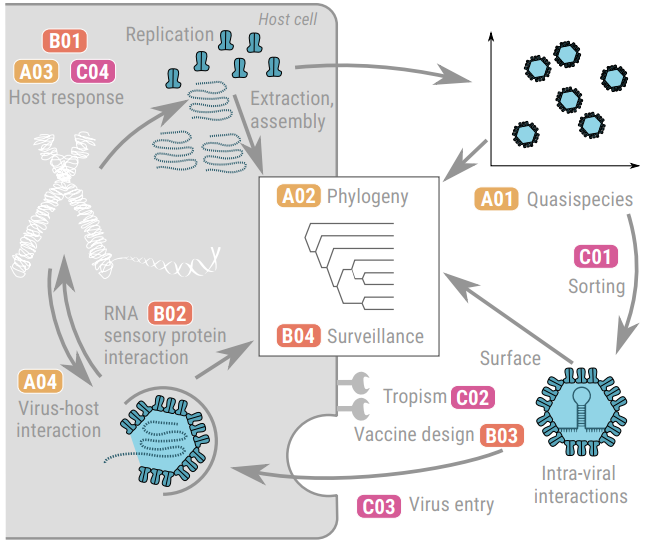
Overview of the individual projects and their interaction within the CRC VirusREvolution.