
VirusREvolution aims to involve young scientists in cutting-edge interdisciplinary research and to create optimal conditions for the scientific and professional development.
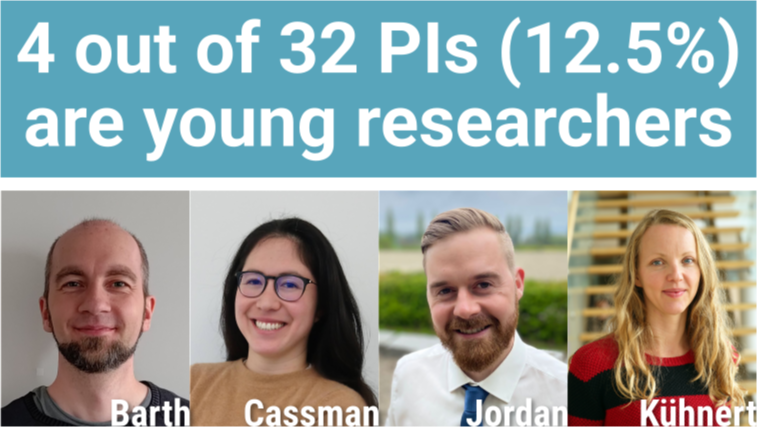
Young Researchers in the CRC VirusREvolution. The CRC VirusREvolution, in line with FSU, recognises that promotion of early-stage scientific careers should continue beyond the PhD and postdoctoral level. FSU has established funds to help young postdocs to conduct research toward the submission of their first research proposal in the role of a principal investigator. VirusREvolution specifically fosters the development of the independent careers of D. Kühnert (A02), P. Jordan (B02), E. Barth (Z02), and N. Cassman (Z02).
Researchers in early career phases
One of the central aims of CRC VirusREvolution is to place early-career scientists at the core of a cutting-edge, interdisciplinary research environment. Here, virology, bioinformatics, photonics, analytical chemistry, and biomedical imaging intersect and inspire one another. From the outset, the CRC provides an exceptionally supportive framework that enables young researchers to thrive academically and scientifically.
Beyond training the next generation of experts, CRC VirusREvolution fosters a vibrant research culture that encourages curiosity, scientific independence, methodological rigor, and collaborative thinking. This environment is designed to attract highly motivated and talented researchers from around the world, creating an international and interdisciplinary community in which ideas, expertise, and innovation can flourish—advancing virus research in Germany.
To ensure transparency, fairness, and accountability, an ombudsperson from the CRC Steering Committee is available as a confidential mediator in cases of supervisory conflict or unforeseen challenges (see Section Z05 for details).
Support for Bachelor’s and Master’s students.
B.Sc./M.Sc. support
- Early Bachelor’s/Master’s integration via internships and theses
- Career Point, House for Early Career Researchers, and Graduate Academy support
- Access to thematic courses and partner research environments
- Joint funding of student research assistants by FSU and CRC funds
Support for doctoral researchers.
Courses of the IRTG will be held in English and the benefits will include:
- Structured interdisciplinary training in virology, bioinformatics, analytical chemistry, and biomedical imaging
- Seminars, method courses, workshops, and hands-on training for depth and breadth
- Monthly CRC seminars and annual retreats to strengthen collaboration
- Public outreach to develop communication skills together with Z04 (Fabisch/Marz)
- Being part of the Jena Graduate Academy (JGA) (20 graduate schools, 16 research training groups, incl. JSMC), with access to 100+ workshops/year
- Following the Salzburg Principles; member of EUA-CDE and Coimbra Group Doctoral Studies Working Group.
Doctoral researchers in the CRC will additionally benefit from the strong local graduate school landscape, including the International Leibniz Research School (ILRS) at the Leibniz-HKI and the International Max Planck Research School (IMPRS) at the Max Planck Institute for Chemical Ecology, both of which provide interdisciplinary training, competitive course programmes, and international recruitment pipelines highly relevant to our virology-imaging-computational focus.
Doctoral support
- Interdisciplinary training: virology, bioinformatics, chemistry, imaging
- Hands-on projects, seminars, and annual CRC retreats
- Science communication courses to develop communication skills
- Embedded in FSU Jena Graduate Academy (incl. JSMC)
- Follows Salzburg Principles
Support for postdoctoral researchers.
Postdoctoral support
- Coordinate subprojects, mentor doctoral researchers, lead method schools
- Advance cross-disciplinary research and pilot independent projects
- Contribute to CRC outreach, enhancing communication skills
- Access to Graduate Academy training, courses, and certification programmes
- Internal seed funding supports independent postdoc research
Support for researchers in early career phases at external participating institutions. Although each participating institution provides supportive structures for early-career researchers, all CRC VirusREvolution members are invited to participate in the comprehensive training offered at FSU Jena, described above. Here, we briefly summarise the supportive structures available at each partner institution: Leibniz Institute on Aging – Fritz Lipmann Institute – FLI: FLI Graduate School offers structured doctoral curricula, method workshops, and career training; Leibniz Institute for Natural Product Research and Infection Biology – Hans Knöll Institute – HKI: Access via JSMC, providing interdisciplinary training in microbiology, infection biology, and systems analysis; Leibniz Institute of Photonic Technology – IPHT: IPHT Graduate Programme supports photonics, spectroscopy, and imaging techniques; University of Leipzig: Graduate Academy Leipzig provides doctoral training, mobility funding, and internationalisation; Justus Liebig University Giessen: Giessen Graduate Centre for Life Sciences (GGL); Ludwig-Maximilians-Universität Munich: LMU GraduateCenter; Westfälische Wilhelms-Universität Münster: Graduate Centre WWU; and Friedrich- Loeffler-Institut: FLI Career Development provides structured doctoral programmes, biological safety level (BSL)-3/4 training, and workshops in virus research.
This integration ensures that early career researchers, whether internal or external, benefit from a shared, interdisciplinary CRC vision and are embedded in a strong network for professional and scientific growth. Summarising the above, early career researchers will greatly benefit from the CRC VirusREvolution and its IRTG. We argue that the rich, interdisciplinary research environment of the proposed programme will create excellent conditions for the scientific and professional development of our doctoral researchers.