
Project Area Z
Integrating activities and central tasks
Project Area Z provides the essential research infrastructure, data management, and public communication that enable and connect all projects within the CRC VirusREvolution.
Why this matters
-
Reliable virus particles, host material, and infection systems are essential for developing and validating all CRC tools
-
Centralised bioinformatic infrastructure ensures that data from all projects is stored, shared, and analysed consistently
-
Integrated data collection enables cross-project comparisons and long-term reuse
-
Public communication ensures that scientific findings reach society in a responsible and understandable way
-
Transparent outreach helps counter misinformation about viruses and infections
-
The CRC combines fundamental virology research with a strong mission in public education
Central Tasks of the Collaborative Research Centre
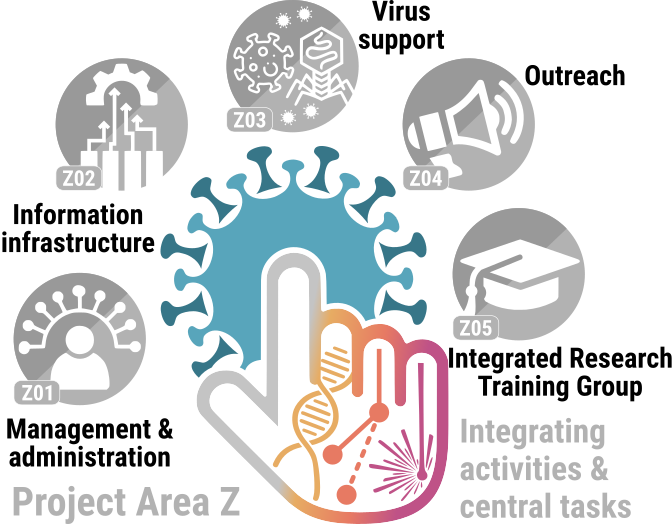
Central tasks. The tasks in the central project Z01 of the CRC VirusREvolution are (1) the management of the CRC with regard to governance, project funds, reporting, staff, travel, and guest scientists; (2) the close collaboration with the other Z-projects Z02, Z03, Z04, and Z05, to support data management and synergy, international visibility and science communication, and the promotion of early career researchers, respectively; (3) the implementation of measures to promote equal opportunities, diversity, and sustainability; (4) the representation and communication of the CRC towards the DFG, partner institutions, and FSU Jena; and (5) the organisation of the scientific VirusREvolution events, such as meetings, symposia, retreats, and workshops, to foster internal communication and strong interactions.
Governance of CRC VirusREvolution. The governance of the CRC is formed by a managing board, Fig. Z01.1, comprising the spokesperson M. Marz (A04) and the four co-spokespersons, of which F. Weber (A03), S. Böcker (B01), and C. Eggeling (C01, C03) represent the three focal areas, and S. Deinhardt-Emmer (C02) our main local virologist and Gender Equality Officer. The board meets twice a year to evaluate the project progress and to plan scientific meetings. It is responsible for devising and implementing measures to promote the CRC towards its scientific objectives.
A scientific coordinator and an administrative assistant (10 h/week) will support the managing board and the central project Z01 with the administrative coordination and organisation of the general tasks (1) to (4). Additionally, the scientific coordinator will take on task (5), which is central to our CRC’s uniquely designed tandem-PI project structure and its three-layer concept described in Research strategy and structure of the CRC.
The CRC will establish an external Scientific Advisory Board (SAB) that will convene once per year at the annual retreat or bi-annually. The SAB will support the CRC managing board with strategic decisions, quality control, and adjustments towards novel developments within the field. Two outstanding candidates have already been secured for the SAB: Robert Edwards (Flinders University, Australia) and Lia van der Hoek (Amsterdam UMC, the Netherlands).
Internal communication and synergy. The heart of our CRC VirusREvolution is its three-layer communication structure, which makes our CRC unique, see Research strategy and structure of the CRC.
By connecting researchers (a) within tandem projects, (b) across the three project areas, and especially (c) our meetings around the overarching research questions defined on p. 37 to create a dynamic environment where ideas are expected to flow freely, expertise is integrated, and innovation is sparked.
Organising these meetings requires substantial effort from the scientific coordinator, who ensures that diverse methodological perspectives and research priorities are brought together effectively. These interactions serve as essential platforms for sharing progress, generating creative solutions to laboratory hypotheses, identifying new applications for our tools, and maintaining consistency in data interpretation and methodologies. Our targeted workshops are dedicated sessions that focus on one single, well-defined research question, see p. 37 and further strengthen collaboration by addressing shared challenges and stimulating novel approaches. This vibrant, structured internal communication is a cornerstone of our CRC and a key driver for achieving its long-term scientific ambitions. These interactions will make our CRC VirusREvolution truely special.



INFormation, INFormatics, and INFrastructure
The Z-Project INFormation, INFormatics, and INFrastructure will provide data management, processing, and integration services to all projects of the CRC VirusREvolution and will focus on creating extensive data models of the training viruses, starting with SARS-CoV-2 and vibriophage N4. The services include (i) research data management (RDM) support, including creating and executing a data management plan, developing a common entry point for the data exchange, and training and helpdesk support for all CRC members, (ii) extending and supporting data integration for all CRC projects into the NFDI4Microbiota virus database VirJenDB, (iii) fundamental bioinformatics services providing and executing software pipelines and tools, and (iv) assistance in the FAIRification of the software tools developed in the CRC VirusREvolution. In addition, together with the respective experts, we will create comprehensive data models and facilitate access for all projects to the data gathered and generated in the CRC. Finally, based on the vibriophage N4 and the SARS-CoV-2 model systems, we aim to develop a multi-modal framework to describe the host reaction to virus infection based on standard processing and integration of transcriptomic, metabolomic, proteomic, and Raman spectroscopy data provided by A04 (Marz/ Papenfort), Z03 (Fröhlich/Höppener/Reiche), A03 (Hoffmann/Weber), B01 (Böcker/Pohnert), and C04 (Beer/Popp). To this end, we will also include the proteomics data that we will generate and evaluate in collaboration with the Proteomics Facility from the Jena University Hospital.




Virus Support
The CRC VirusREvolution brings together diverse approaches to create tools for virology research, using vibriophage N4 and SARS-CoV-2 as initial training viruses. These tools can later be applied to a broad range of bacteriophages and eukaryotic viruses. To support these subprojects, the central project Z03 will provide key material and technology. Specifically, Z03 will isolate, propagate, purify, inactivate, and characterise eukaryotic viruses and bacteriophages as required by the individual subprojects. Additionally, electron microscopy data will be supplied to aid in the characterisation and provide a deeper understanding of virus-cell interactions, interconnecting this project with all research questions and goals. Importantly, Z03 will also ensure comprehensive and continuous documentation of bacteriophages and viruses used in individual subprojects together with Z02 (Barth/ Cassman/Gerlach/König-Ries). The central project Z03 will furthermore oversee all necessary regulations for work in the laboratories of the individual subgroups and will organise the transfer of characterised virus isolates as well as virus antigens or nucleic acids.



Science Communication: Virus impact on human life
The science communication project of CRC VirusREvolution seeks to bring the world of viruses closer to the public by translating cutting-edge research into formats that are accessible, engaging, and reliable. We are motivated by widespread fear and uncertainty about viruses, which we aim to address by providing clear, trustworthy, and understandable information. Public interest in virology surged during the pandemic, highlighting both the desire for knowledge and the societal need for clear explanations of how scientific findings underpin political and health decisions. Understanding viruses requires a solid grasp of bioinformatics and photonics, so this project integrates these fields into its science communication strategy. We aim not only to raise awareness of viruses across human, animal, plant, and microbial systems but also to inspire curiosity in the next generation of experimental, computational, and photonic researchers through interactive and accessible content.
Our approach combines complementary formats to maximise reach and impact. The project is structured into four interconnected work packages that together balance breadth and depth: transferring essential knowledge, presenting current research, enabling dialogue, and fostering engagement across all age groups. A German-language blog at high-school level will provide fundamental knowledge with fact-based, visually supported articles, interactive figures, and lab-based material suitable for school lessons. A monthly podcast will highlight CRC research in an authentic, accessible way, including interviews, lab demonstrations, quizzes, and insights into incremental scientific progress. Social media channels such as Instagram, LinkedIn, and Bluesky will share news, promote the blog and podcast, and engage audiences directly with polls and interactive content to clarify misconceptions. These efforts will be complemented by general outreach activities, including corporate design, website, public talks, science festivals, media appearances, and 3D virus models, ensuring visibility from pupils to the broader public and scientific community. Early-career researchers will be involved in planning and content creation, providing communication training while contributing fresh perspectives.
To ensure effectiveness, we will employ a robust evaluation framework tracking quantitative and qualitative indicators and draw on the broad communication expertise of our PIs and institutional partners. By implementing this multichannel, inclusive, and carefully evaluated strategy, CRC VirusREvolution will not only disseminate knowledge about viruses and related fields but also reduce fear, promote scientific literacy, empower informed public discourse, and strengthen trust in science, while preparing society for future challenges and inspiring the scientists of tomorrow.

Science Communication: Virus impact on human life
The Integrated Research Training Group (IRTG) of CRC VirusREvolution translates the consortium’s mission into a structured doctoral programme. It trains our >25 early-career researchers (ECRs) in hypothesis-driven virology, bioinformatics, and photonics, complemented by transferable skills in ethics, data management, communication, leadership, and mental health awareness. The programme follows the Salzburg Principles and the UniWinD competence framework. Through modular, level-specific courses and innovative teaching formats such as hackathons and flipped classrooms, the IRTG fosters creativity, autonomy, interdisciplinarity, and emphasizes the scientific independence of its members. Distinctive elements include interdisciplinary PhD–PhD tandems that bridge virology, bioinformatics, and photonics, ensuring both cross-disciplinary collaboration and the inclusion of externally based PhDs. All supervisors participate in mandatory training on supervision, diversity, and mental health awareness. Individual Development Plans (IDPs) guide scientific and personal skill development, while continuous evaluation through Thesis Advisory Committee (TAC) reports, feedback surveys, and doctoral representation ensures programme quality. Integration within the Jena Graduate Academy (JGA) and collaboration with partner graduate schools secure institutional alignment and access to advanced training opportunities. The IRTG builds a collaborative, inclusive, and internationally visible training culture, preparing graduates for careers in academia, industry, and beyond.