


Uncovering viral glycoprotein conformational dynamics for rational vaccine design
Structure-based prediction and design have made tremendous progress over the last thirty years with Rosetta and, especially, since 2021, when AlphaFold2 was released. This progress to achieve the holy grail of computational structural biology was rewarded with the Nobel Prize for these two algorithms in 2024. The accurate prediction of the protein structure is the first step towards an in silico first strategy to design vaccines and antibodies. Structure-based modelling will also provide estimates for host-receptor interactions, such as antibody-antigen complexes. With this information, the missing link between sequence and function can be filled. Here, we are developing methods to predict structures of viral glycoproteins that will allow us to assess emerging viral variants. With structure-based methods, we will investigate the impact of the observed mutations in viral glycoproteins on the structure and the respective conformational states. This is critical for understanding the conformational space that mediates the fusion process. One major step to overcome here is the lack of predictive power of AI tools for structure prediction to provide pre- and post-fusion receptor states. We will subsequently predict the effect these mutations have on the structure. Together with the consortium partners, we will investigate whether our methods predict the effect and the respective function of the viral glycoprotein (variants). The major virus-host interaction we will study is the interaction with the immune system, with the spike protein being the major target of the humoral response to SARS-CoV-2.
Antibodies, as major determinants of this immune response, are useful research tools and therapeutics but are challenging for structure prediction and design. Moreover, antigen-antibody interactions are inherently hard to predict and evaluate, even with emerging AI tools, due to the lack of data and the complexity of the molecular interaction. Here, we will overcome these limitations and develop a new tool termed ANNtibody that takes atomic and electron density calculations into account. Thus far, these methods could not be employed for systems with more than a couple dozen atoms, but the training of AI on electron density data or on Density Functional Theory (DFT) calculations circumvents these resource limited steps. Data from NFDI4Chem and its associated repositories will be used to benchmark these.
With this increase in resolution, we hypothesise that our method will capture the complex interaction network in the antibody-antigen interface more accurately. These calculations will be used to predict antibody- antigen interactions, which we will challenge with the experimental design of antibodies for emerging SARS- CoV-2 variants using antibody interactions with the highly variable receptor-binding domain. With our method, we will update these antibody sequences and test experimentally whether we can overcome viral es- cape. Subsequently, we will design epitope focused immunogens based on SARS-CoV-2 epitopes that will elicit broadly neutralising antibody populations. All experimentally obtained data will be used to refine the developed methods. Data provided by C02 (Deckert/Deinhardt/Emmer) on virus-host interactions, by A02 (Friedel/Kühnert) and NFDI4Microbiota on viral sequences, and by B04 (Dittrich/McHardy) on surveillance will be essential for training and optimising our tool. These datasets will be integrated with our structural features, enabling our tool to generate predictions that will directly inform and support our partner projects. Altogether, we will generate computational structure-based tools that will help answers goals G1 and G3, providing insight into the host-receptor interaction. These tools will allow us to rapidly fight emerging viral infections and tune these tools for vaccine design, probing our ability to generate a broadly neutralising vaccine.
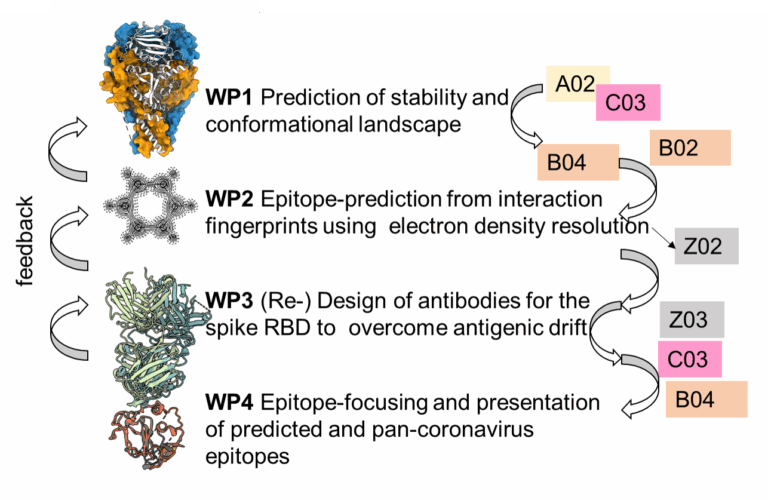
- WP 1: Prediction of stability and conformational landscape of viral glycoprotein with artificial-intelligence tools taking antigenic drift into consideration (Meiler, Schoeder)
- WP 2: Epitope prediction from interaction fingerprints using electron density resolution (Meiler)
- WP 3: (Re-) Design of antibodies for the SARS-CoV-2 spike RBD to overcome antigenic drift (Schoeder, Meiler)
- WP 4: Epitope-focusing and presentation of predicted and pan-coronavirus epitopes (Schoeder)
Team Members



N. N.
Doctoral Researcher
N. N.
Doctoral Researcher
Project-Specific Publications
2026
Daodu, Richard Olumide; Riccabona, Jakob R; Peter, Antonia Sophia; Ulrich, Jens-Uwe; von Creytz, Isabel; Prescott, Joseph B; Reinert, Knut; Schoeder, Clara T; Kühnert, Denise
Sequence to structure insights into Lassa virus population-level biophysical properties and glycoprotein structure catalogue Journal Article
In: Npj Viruses, vol. 4, no. 1, 2026, ISSN: 2948-1767.
@article{pmid42135491,

title = {Sequence to structure insights into Lassa virus population-level biophysical properties and glycoprotein structure catalogue},

author = {Richard Olumide Daodu and Jakob R Riccabona and Antonia Sophia Peter and Jens-Uwe Ulrich and Isabel von Creytz and Joseph B Prescott and Knut Reinert and Clara T Schoeder and Denise Kühnert},

doi = {10.1038/s44298-026-00196-3},

issn = {2948-1767},

year  = {2026},

date = {2026-05-01},

urldate = {2026-05-01},

journal = {Npj Viruses},

volume = {4},

number = {1},

abstract = {Lassa virus (LASV) remains a major public health threat in West Africa, with recurrent outbreaks, exported cases, and no licensed vaccine. LASV lineages are geographically separated and differ in immunogenicity and pathogenicity; however, the fundamental biophysical properties that may explain these differences remain poorly defined. Here, we analyse LASV protein properties at the population scale across lineages, focusing on the glycoprotein (GP), the principal target of humoral immunity. Across hundreds of curated sequences, protein length variation is driven primarily by short indels, with pronounced variation in the RNA polymerase and a recurrent one-amino-acid difference in GP. In parallel, population-scale analyses reveal subtle lineage- and protein-specific differences in amino-acid composition across the LASV proteins. Despite co-circulation in Nigeria, S-segment-encoded proteins from lineage III are consistently heavier than those from lineage II. An integrative framework combining random forest feature importance, Manhattan-distance profiling, Pearson correlation, and amino-acid composition analyses reveals that lineage III GPs are ~180 Da heavier on average, driven by shifts toward the use of heavier residues at specific sites. Population-scale computational structural modelling and flow-cytometric assays indicate that the N-terminal GP1 indel is structurally and functionally tolerated. Together, these findings define lineage-specific biophysical patterns in LASV and provide a catalogue of GP structures to inform vaccine and therapeutic design.},

keywords = {},

pubstate = {published},

tppubtype = {article}

}
Lassa virus (LASV) remains a major public health threat in West Africa, with recurrent outbreaks, exported cases, and no licensed vaccine. LASV lineages are geographically separated and differ in immunogenicity and pathogenicity; however, the fundamental biophysical properties that may explain these differences remain poorly defined. Here, we analyse LASV protein properties at the population scale across lineages, focusing on the glycoprotein (GP), the principal target of humoral immunity. Across hundreds of curated sequences, protein length variation is driven primarily by short indels, with pronounced variation in the RNA polymerase and a recurrent one-amino-acid difference in GP. In parallel, population-scale analyses reveal subtle lineage- and protein-specific differences in amino-acid composition across the LASV proteins. Despite co-circulation in Nigeria, S-segment-encoded proteins from lineage III are consistently heavier than those from lineage II. An integrative framework combining random forest feature importance, Manhattan-distance profiling, Pearson correlation, and amino-acid composition analyses reveals that lineage III GPs are ~180 Da heavier on average, driven by shifts toward the use of heavier residues at specific sites. Population-scale computational structural modelling and flow-cytometric assays indicate that the N-terminal GP1 indel is structurally and functionally tolerated. Together, these findings define lineage-specific biophysical patterns in LASV and provide a catalogue of GP structures to inform vaccine and therapeutic design.
2025
Ertelt, Moritz; Moretti, Rocco; Meiler, Jens; Schoeder, Clara T
Self-supervised machine learning methods for protein design improve sampling but not the identification of high-fitness variants. Journal Article
In: Science advances, vol. 11, iss. 7, pp. eadr7338, 2025.
@article{Ertelt:25,

title = {Self-supervised machine learning methods for protein design improve sampling but not the identification of high-fitness variants.},

author = {Moritz Ertelt and Rocco Moretti and Jens Meiler and Clara T Schoeder},

url = {https://pubmed.ncbi.nlm.nih.gov/39937901/},

doi = {10.1126/sciadv.adr7338},

year  = {2025},

date = {2025-02-01},

journal = {Science advances},

volume = {11},

issue = {7},

pages = {eadr7338},

keywords = {},

pubstate = {ppublish},

tppubtype = {article}

}
2024
Ertelt, Moritz; Meiler, Jens; Schoeder, Clara T
Combining Rosetta sequence design with protein language model predictions using evolutionary scale modeling (ESM) as restraint. Journal Article
In: ACS synthetic biology, vol. 13, iss. 4, no. 4, pp. 1085–1092, 2024.
@article{Ertelt:24:rosetta,

title = {Combining Rosetta sequence design with protein language model predictions using evolutionary scale modeling (ESM) as restraint.},

author = {Moritz Ertelt and Jens Meiler and Clara T Schoeder},

url = {https://pubmed.ncbi.nlm.nih.gov/38568188/},

doi = {10.1021/acssynbio.3c00753},

year  = {2024},

date = {2024-04-01},

journal = {ACS synthetic biology},

volume = {13},

number = {4},

issue = {4},

pages = {1085–1092},

keywords = {},

pubstate = {ppublish},

tppubtype = {article}

}
Ertelt, Moritz; Mulligan, Vikram Khipple; Maguire, Jack B; Lyskov, Sergey; Moretti, Rocco; Schiffner, Torben; Meiler, Jens; Schoeder, Clara T
Combining machine learning with structure-based protein design to predict and engineer post-translational modifications of proteins. Journal Article
In: PLoS Comput Biol, vol. 20, iss. 3, no. 3, pp. e1011939, 2024.
@article{Ertelt:24:machine,

title = {Combining machine learning with structure-based protein design to predict and engineer post-translational modifications of proteins.},

author = {Moritz Ertelt and Vikram Khipple Mulligan and Jack B Maguire and Sergey Lyskov and Rocco Moretti and Torben Schiffner and Jens Meiler and Clara T Schoeder},

url = {https://pubmed.ncbi.nlm.nih.gov/38484014/},

doi = {10.1371/journal.pcbi.1011939},

year  = {2024},

date = {2024-03-01},

journal = {PLoS Comput Biol},

volume = {20},

number = {3},

issue = {3},

pages = {e1011939},

publisher = {Public Library of Science (PLoS)},

keywords = {},

pubstate = {epublish},

tppubtype = {article}

}
2023
Sala, D; Engelberger, F; Mchaourab, H S; Meiler, J
Modeling conformational states of proteins with AlphaFold Journal Article
In: Curr Opin Struct Biol, vol. 81, pp. 102645, 2023.
@article{Sala:23,

title = {Modeling conformational states of proteins with AlphaFold},

author = {D Sala and F Engelberger and H S Mchaourab and J Meiler},

url = {https://www.sciencedirect.com/science/article/pii/S0959440X23001197},

doi = {10.1016/j.sbi.2023.102645},

year  = {2023},

date = {2023-08-01},

journal = {Curr Opin Struct Biol},

volume = {81},

pages = {102645},

keywords = {},

pubstate = {ppublish},

tppubtype = {article}

}
Sala, Davide; Hildebrand, Peter W; Meiler, Jens
Biasing AlphaFold2 to predict GPCRs and kinases with user-defined functional or structural properties Journal Article
In: Front Mol Biosci, vol. 10, pp. 1121962, 2023.
@article{Sala:23:biasing,

title = {Biasing AlphaFold2 to predict GPCRs and kinases with user-defined functional or structural properties},

author = {Davide Sala and Peter W Hildebrand and Jens Meiler},

url = {https://www.frontiersin.org/articles/10.3389/fmolb.2023.1121962},

doi = {10.3389/fmolb.2023.1121962},

year  = {2023},

date = {2023-01-01},

journal = {Front Mol Biosci},

volume = {10},

pages = {1121962},

keywords = {},

pubstate = {epublish},

tppubtype = {article}

}
2022
Schoeder, Clara T; Gilchuk, Pavlo; Sangha, Amandeep K; Ledwitch, Kaitlyn V; Malherbe, Delphine C; Zhang, Xuan; Binshtein, Elad; Williamson, Lauren E; Martina, Cristina E; Dong, Jinhui; Armstrong, Erica; Sutton, Rachel; Nargi, Rachel; Rodriguez, Jessica; Kuzmina, Natalia; Fiala, Brooke; King, Neil P; Bukreyev, Alexander; Crowe, James E; Meiler, Jens
Epitope-focused immunogen design based on the ebolavirus glycoprotein HR2-MPER region Journal Article
In: PLoS Pathog, vol. 18, iss. 5, no. 5, pp. 1-29, 2022.
@article{Schoeder:22,

title = {Epitope-focused immunogen design based on the ebolavirus glycoprotein HR2-MPER region},

author = {Clara T Schoeder and Pavlo Gilchuk and Amandeep K Sangha and Kaitlyn V Ledwitch and Delphine C Malherbe and Xuan Zhang and Elad Binshtein and Lauren E Williamson and Cristina E Martina and Jinhui Dong and Erica Armstrong and Rachel Sutton and Rachel Nargi and Jessica Rodriguez and Natalia Kuzmina and Brooke Fiala and Neil P King and Alexander Bukreyev and James E Crowe and Jens Meiler},

editor = {Thomas Hoenen},

url = {https://doi.org/10.1371/journal.ppat.1010518},

doi = {10.1371/journal.ppat.1010518},

year  = {2022},

date = {2022-05-01},

journal = {PLoS Pathog},

volume = {18},

number = {5},

issue = {5},

pages = {1-29},

publisher = {Public Library of Science},

keywords = {},

pubstate = {epublish},

tppubtype = {article}

}
Alamo, Diego Del; Sala, Davide; Mchaourab, Hassane S; Meiler, Jens
Sampling alternative conformational states of transporters and receptors with AlphaFold2 Journal Article
In: eLife, vol. 11, pp. e75751, 2022.
@article{Alamo:22,

title = {Sampling alternative conformational states of transporters and receptors with AlphaFold2},

author = {Diego Del Alamo and Davide Sala and Hassane S Mchaourab and Jens Meiler},

editor = {Janice L Robertson and Kenton J Swartz and Janice L Robertson},

url = {https://doi.org/10.7554/eLife.75751},

doi = {10.7554/eLife.75751},

year  = {2022},

date = {2022-03-01},

journal = {eLife},

volume = {11},

pages = {e75751},

publisher = {eLife Sciences Publications, Ltd},

keywords = {},

pubstate = {epublish},

tppubtype = {article}

}
2021
Schoeder, Clara T; Schmitz, Samuel; Adolf-Bryfogle, Jared; Sevy, Alexander M; Finn, Jessica A; Sauer, Marion F; Bozhanova, Nina G; Mueller, Benjamin K; Sangha, Amandeep K; Bonet, Jaume; Sheehan, Jonathan H; Kuenze, Georg; Marlow, Brennica; Smith, Shannon T; Woods, Hope; Bender, Brian J; Martina, Cristina E; Alamo, Diego Del; Kodali, Pranav; Gulsevin, Alican; Schief, William R; Correia, Bruno E; Crowe, James E; Meiler, Jens; Moretti, Rocco
Modeling immunity with Rosetta: Methods for antibody and antigen design Journal Article
In: Biochemistry, vol. 60, iss. 11, pp. 825–846, 2021.
@article{Schoeder:21,

title = {Modeling immunity with Rosetta: Methods for antibody and antigen design},

author = {Clara T Schoeder and Samuel Schmitz and Jared Adolf-Bryfogle and Alexander M Sevy and Jessica A Finn and Marion F Sauer and Nina G Bozhanova and Benjamin K Mueller and Amandeep K Sangha and Jaume Bonet and Jonathan H Sheehan and Georg Kuenze and Brennica Marlow and Shannon T Smith and Hope Woods and Brian J Bender and Cristina E Martina and Diego Del Alamo and Pranav Kodali and Alican Gulsevin and William R Schief and Bruno E Correia and James E Crowe and Jens Meiler and Rocco Moretti},

doi = {10.1021/acs.biochem.0c00912},

year  = {2021},

date = {2021-01-01},

journal = {Biochemistry},

volume = {60},

issue = {11},

pages = {825–846},

keywords = {},

pubstate = {published},

tppubtype = {article}

}
2020
Alexander, Matthew R; Schoeder, Clara T; Brown, Jacquelyn A; Smart, Charles D; Moth, Chris; Wikswo, John P; Capra, John A; Meiler, Jens; Chen, Wenbiao; Madhur, Meena S
Predicting susceptibility to SARS-CoV-2 infection based on structural differences in ACE2 across species Journal Article
In: The FASEB Journal, vol. 34, iss. 12, no. 12, pp. 15946-15960, 2020.
@article{Alexander:20,

title = {Predicting susceptibility to SARS-CoV-2 infection based on structural differences in ACE2 across species},

author = {Matthew R Alexander and Clara T Schoeder and Jacquelyn A Brown and Charles D Smart and Chris Moth and John P Wikswo and John A Capra and Jens Meiler and Wenbiao Chen and Meena S Madhur},

url = {https://pubmed.ncbi.nlm.nih.gov/33015868/},

doi = {10.1096/fj.202001808R},

year  = {2020},

date = {2020-12-01},

journal = {The FASEB Journal},

volume = {34},

number = {12},

issue = {12},

pages = {15946-15960},

publisher = {Wiley},

keywords = {},

pubstate = {ppublish},

tppubtype = {article}

}
Sauer, Marion F; Sevy, Alexander M; Crowe, James E; Meiler, Jens
Multi-state design of flexible proteins predicts sequences optimal for conformational change Journal Article
In: PLoS Comput Biol, vol. 16, iss. 2, pp. e1007339, 2020.
@article{Sauer:20,

title = {Multi-state design of flexible proteins predicts sequences optimal for conformational change},

author = {Marion F Sauer and Alexander M Sevy and James E Crowe and Jens Meiler},

url = {https://pubmed.ncbi.nlm.nih.gov/32032348/},

doi = {10.1371/journal.pcbi.1007339},

year  = {2020},

date = {2020-02-01},

journal = {PLoS Comput Biol},

volume = {16},

issue = {2},

pages = {e1007339},

publisher = {Public Library of Science (PLoS)},

keywords = {},

pubstate = {epublish},

tppubtype = {article}

}