


RNA determinants of the antiviral innate immune response
Viral RNAs trigger the innate immune response, which is able not only to distinguish foreign RNA from the cell’s own diverse complement of RNA molecules, but also varies among viral pathogens. Macrophages act as the first line of defence against invading viruses and are pivotal for the innate immune response, crucially regulating the entire inflammatory process during viral infections. Single- or double-stranded RNA viruses are recognised by several classes of RNA-binding proteins, in particular, the RNA-dependent toll-like receptors (TLR), TLR-7 and TLR-8, the RIG-I-like receptors (RLR) RIG-I, MDA5, LGP2, and their homologues, and the double-strand sensing protein kinase R (PKR). While individual RNA ligands of these sensory proteins have been well studied, a comprehensive and comparative understanding of their evolutionary and structural diversity across viral groups remains lacking.
In our project, we therefore aim to determine systematically the key features of both RNA sequence and RNA structure required for binding to these sensory proteins and for the subsequent activation of the innate immune response. We aim to make this connection actionable by developing a comprehensive predictive toolkit, RNAinnate, designed to predict the tempo and mode of activation of the innate immune system from the viral RNA sequence.
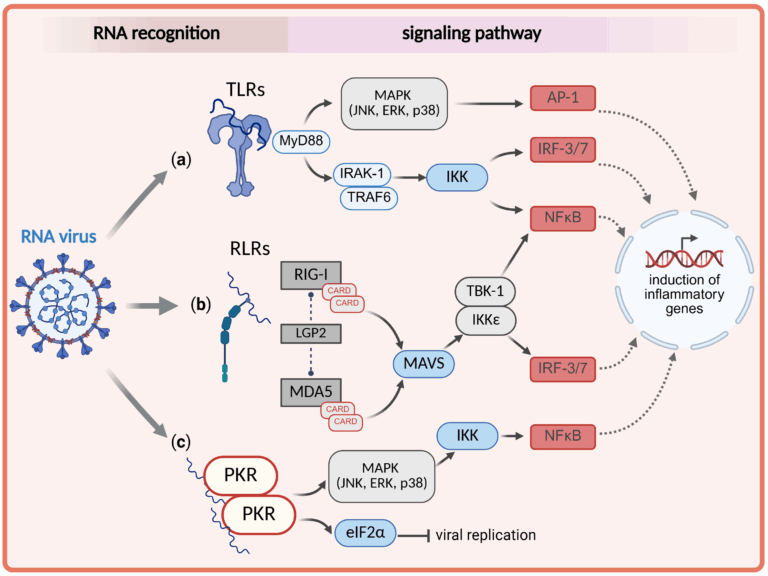
In detail, we will first investigate the specificity of RNA-protein binding for each purified RNA sensor in vitro, using randomised synthesised RNA libraries and employing cross-linking and immunoprecipitation sequencing methods (CLIP-seq). We will then transfect cells with distinct RNA sequences to validate our findings on the purified RNA sensors using electroporation- and DharmaFECT-based transfection. We will establish a transfection protocol using human lung epithelial cells (A549 cells and Calu-3 cells) and subsequently apply this technique to human primary macrophages. We will thoroughly examine the innate immune response, in particular the subsequent phosphorylation of downstream kinases of the specific RNA-binding proteins in the lung epithelial cells and in the macrophages. Afterwards, we will infect lung epithelial cells and human macrophages with SARS-CoV-2 to investigate virus-specific RNA-protein binding. Ultimately, we will infect cells in parallel with intact SARS-CoV-2, influenza A virus (IAV), and respiratory syncytial virus (RSV) to map the previously identified triggering elements within their natural genomic contexts. In order to determine characteristics of binding RNAs, we will evaluate enrichment and depletion of features such as secondary structure elements and local sequence motifs, as well as assess the distribution of folding energies. Moreover, we will employ unsupervised clustering techniques on these features, and combine the results of the different methods to extract descriptors of binding patterns in the form of covariance models and Bayesian descriptors similar to Dimont. Besides the determination of the RNA sequences, we will analyse the transcriptomic, metabolomic, and lipidomic changes of human primary macrophages related to the specific RNA sensors that occur following distinct RNA recognition. Finally, we will uncover evidence of selection pressure that removes or attenuates the individual RNA trigger elements for the innate immune system, providing insights into the mechanisms of RNA genome evolution. To achieve the latter goal, scalable, high-quality alignments of viral genomes are required that can combine inter-species comparison with information of strain-level variations. As no such tool exists, we fill this gap with VirAligner, using novel combinations of existing approaches in comparative sequence analysis.
We aim to understand the sequence and structure requirements of viral RNAs that are necessary to trigger the innate immune system, and to disentangle the reasons for differences in the response. This overarching biological question requires that we tackle the following research tasks:
- WP 1: Identification RNA features (Jordan/Stadler)
- WP 2: Identification of triggering patterns to activate innate immune response (Jordan/Stadler)
- WP 3: Triggering elements in viral genomes (Jordan/Stadler)
- WP 4: Evolutionary Implications (Stadler)
- WP 5: Identifying antiviral treatment strategies in the event of pandemic outbreak (Jordan)
Team Members



N. N.
Doctoral Researcher
N. N.
Doctoral Researcher

Project-Specific Publications
2026
Soltaninezhad, Mohammad; Rouzbahani, Yashar; Contreras, Jhonatan; Larios, Francisco Paez; Jordan, Paul M; Werz, Oliver; Chippalkatti, Rohan; Abankwa, Daniel Kwaku; Eggeling, Christian; Bocklitz, Thomas
Lightweight CycleGAN models for cross-modality image transformation and experimental quality assessment in fluorescence microscopy Journal Article
In: Biomed Opt Express, vol. 17, no. 3, pp. 1476–1498, 2026, ISSN: 2156-7085.
@article{pmid41970592,

title = {Lightweight CycleGAN models for cross-modality image transformation and experimental quality assessment in fluorescence microscopy},

author = {Mohammad Soltaninezhad and Yashar Rouzbahani and Jhonatan Contreras and Francisco Paez Larios and Paul M Jordan and Oliver Werz and Rohan Chippalkatti and Daniel Kwaku Abankwa and Christian Eggeling and Thomas Bocklitz},

doi = {10.1364/BOE.578297},

issn = {2156-7085},

year  = {2026},

date = {2026-03-01},

urldate = {2026-03-01},

journal = {Biomed Opt Express},

volume = {17},

number = {3},

pages = {1476--1498},

abstract = {With the growing integration of artificial intelligence in scientific and medical applications, lightweight deep learning models have become increasingly important. These models offer substantial reductions in memory usage and computational time. Given that GPU-based model training and inference contribute significantly to carbon emissions, lightweight architectures with comparable performance to parameter-rich models present a more environmentally friendly alternative. Specifically, we build upon CycleGAN with a fixed-channel lightweight U-Net generator for modality transfer from standard confocal to super-resolution STED and deconvolved STED images, and systematically compare it against Pix2Pix and standard CycleGAN baselines. Obtaining paired datasets in medical imaging and super-resolution microscopy is often infeasible due to the need for additional experiments and the intrinsic complexity of biological sample preparation. To address this, we investigate the performance of lightweight CycleGAN models, demonstrating their ability to achieve high-fidelity modality transfer despite reduced model complexity. We introduce a fixed channel strategy within the U-Net-based generator, in contrast to the traditional channel-doubling approach. This modification significantly reduces the number of trainable parameters from 41.8 million to approximately 9 thousand, while achieving comparable or slightly improved performance. We explore the utility of GAN models as a qualitative marker for assessing experimental and labeling quality. When trained on high-quality microscopy images, the GAN implicitly learns the characteristics of optimal imaging. Deviations between GAN-generated outputs trained on high-quality data and low-quality experimental images can highlight potential issues such as photobleaching, experimental artifacts, or inaccurate labeling. In this way, the model can support qualitative assessment of experimental consistency and image fidelity in fluorescence microscopy workflows.},

keywords = {},

pubstate = {published},

tppubtype = {article}

}
With the growing integration of artificial intelligence in scientific and medical applications, lightweight deep learning models have become increasingly important. These models offer substantial reductions in memory usage and computational time. Given that GPU-based model training and inference contribute significantly to carbon emissions, lightweight architectures with comparable performance to parameter-rich models present a more environmentally friendly alternative. Specifically, we build upon CycleGAN with a fixed-channel lightweight U-Net generator for modality transfer from standard confocal to super-resolution STED and deconvolved STED images, and systematically compare it against Pix2Pix and standard CycleGAN baselines. Obtaining paired datasets in medical imaging and super-resolution microscopy is often infeasible due to the need for additional experiments and the intrinsic complexity of biological sample preparation. To address this, we investigate the performance of lightweight CycleGAN models, demonstrating their ability to achieve high-fidelity modality transfer despite reduced model complexity. We introduce a fixed channel strategy within the U-Net-based generator, in contrast to the traditional channel-doubling approach. This modification significantly reduces the number of trainable parameters from 41.8 million to approximately 9 thousand, while achieving comparable or slightly improved performance. We explore the utility of GAN models as a qualitative marker for assessing experimental and labeling quality. When trained on high-quality microscopy images, the GAN implicitly learns the characteristics of optimal imaging. Deviations between GAN-generated outputs trained on high-quality data and low-quality experimental images can highlight potential issues such as photobleaching, experimental artifacts, or inaccurate labeling. In this way, the model can support qualitative assessment of experimental consistency and image fidelity in fluorescence microscopy workflows.
Schultz, Constanze; Jordan, Paul Mike; Dahlke, Philipp; Maz, Zehra Tuğçe Gür; Banoğlu, Erden; Meyer-Zedler, Tobias; Schmitt, Michael; Werz, Oliver; Popp, Juergen
In: Chem Sci, vol. 17, no. 3, pp. 1613–1623, 2026, ISSN: 2041-6520.
@article{pmid41522863,

title = {Unveiling the molecular dynamics of a nitrile-containing 5-lipoxygenase-activating protein antagonist in primary macrophages through Raman spectroscopy},

author = {Constanze Schultz and Paul Mike Jordan and Philipp Dahlke and Zehra Tuğçe Gür Maz and Erden Banoğlu and Tobias Meyer-Zedler and Michael Schmitt and Oliver Werz and Juergen Popp},

doi = {10.1039/d5sc09493c},

issn = {2041-6520},

year  = {2026},

date = {2026-01-01},

urldate = {2026-01-01},

journal = {Chem Sci},

volume = {17},

number = {3},

pages = {1613--1623},

abstract = {The nitrile (-C[triple bond, length as m-dash]N) functional group is a versatile pharmacophore motif that also serves as an intrinsic, bioorthogonal Raman tag in the silent wavenumber region (1800-2700 cm). Here, we exploit this dual functionality to track the potent nitrile-containing 5-lipoxygenase-activating protein (FLAP) antagonist BRP-685 in primary human macrophages using label-free spontaneous and stimulated Raman scattering. This approach enables direct intracellular localization at biologically relevant, low micromolar concentrations without chemical modification or external labels. Quantitative Raman imaging reveals that BRP-685 preferentially accumulates in lipid droplets, distinct from its membrane-bound target site at the nuclear envelope/endoplasmic reticulum. Multiplexed analysis with an alkyne-tagged lipid analog uncovers a unique distribution pattern, suggesting that lipid droplets act as intracellular reservoirs for highly lipophilic drugs.},

keywords = {},

pubstate = {published},

tppubtype = {article}

}
The nitrile (-C[triple bond, length as m-dash]N) functional group is a versatile pharmacophore motif that also serves as an intrinsic, bioorthogonal Raman tag in the silent wavenumber region (1800-2700 cm). Here, we exploit this dual functionality to track the potent nitrile-containing 5-lipoxygenase-activating protein (FLAP) antagonist BRP-685 in primary human macrophages using label-free spontaneous and stimulated Raman scattering. This approach enables direct intracellular localization at biologically relevant, low micromolar concentrations without chemical modification or external labels. Quantitative Raman imaging reveals that BRP-685 preferentially accumulates in lipid droplets, distinct from its membrane-bound target site at the nuclear envelope/endoplasmic reticulum. Multiplexed analysis with an alkyne-tagged lipid analog uncovers a unique distribution pattern, suggesting that lipid droplets act as intracellular reservoirs for highly lipophilic drugs.
2025
Klepsch, Lea C; Dahlke, Philipp; Behnke, Mira; Tsarenko, Ekaterina; Göppert, Natalie E; Klemm, Paul; Meyer, Jakob; George, Alan; Chi, Mingzhe; Czaplewska, Justyna A; Vollrath, Antje; Weber, Christine; Jordan, Paul M; Schubert, Stephanie; Hoeppener, Stephanie; Nischang, Ivo; Sierka, Marek; Werz, Oliver; Schubert, Ulrich S
Matching drug and polymer for efficient delivery of anti-inflammatory drugs: PLGA, polyesteramides, and acetalated dextran Journal Article
In: J Mater Chem B, vol. 13, no. 48, pp. 15516–15529, 2025, ISSN: 2050-7518.
@article{pmid41251545,

title = {Matching drug and polymer for efficient delivery of anti-inflammatory drugs: PLGA, polyesteramides, and acetalated dextran},

author = {Lea C Klepsch and Philipp Dahlke and Mira Behnke and Ekaterina Tsarenko and Natalie E Göppert and Paul Klemm and Jakob Meyer and Alan George and Mingzhe Chi and Justyna A Czaplewska and Antje Vollrath and Christine Weber and Paul M Jordan and Stephanie Schubert and Stephanie Hoeppener and Ivo Nischang and Marek Sierka and Oliver Werz and Ulrich S Schubert},

doi = {10.1039/d5tb01949d},

issn = {2050-7518},

year  = {2025},

date = {2025-12-01},

urldate = {2025-12-01},

journal = {J Mater Chem B},

volume = {13},

number = {48},

pages = {15516--15529},

abstract = {The hydrochalcone derivative MF-15 and the synthetically derived BRP-201 are potent anti-inflammatory active pharmaceutical ingredients (APIs) that suffer from poor bioavailability. This necessitates their incorporation into drug delivery systems. To address this limitation, we investigated four polymeric carrier materials. The poly(ester amide)s poly(3-benzylmorpholine-2,5-dione) (PPheG) and poly(3-isopropyl-morpholine-2,5-dione) (PValG), the benchmark poly(lactic--glycolic acid) (PLGA), and the polysaccharide acetalated dextran (Ac-Dex) were used to formulate nanoparticles  nanoprecipitation. The nanoparticles had sizes of around 110 to 190 nm with negative zeta potentials. Although atomistic molecular dynamics (MD) simulations predicted enhanced miscibility of PPheG and PValG with MF-15, the highest loading capacity was achieved with Ac-Dex (4.2 wt%). None of the MF-15-loaded particles elicited a biologic response (, 15-lipoxygenase (LOX)-1 activation) in human M2 monocyte-derived macrophages (MDMs). The consistent failure across all MF-15 formulations, despite differences in polymer composition, drug loading, and enzymatic degradation profiles, suggests that encapsulation inherently interferes with MF-15's ability to activate 15-LOX-1, irrespective of the carrier system. In contrast, all BRP-201-loaded formulations demonstrated potent anti-inflammatory effects in human neutrophils. Overall, our findings demonstrate that polymer-drug miscibility and favorable physicochemical properties alone are insufficient to predict  efficacy, highlighting the importance of kinetic and formulation-dependent factors in the successful delivery of anti-inflammatory agents.},

keywords = {},

pubstate = {published},

tppubtype = {article}

}
The hydrochalcone derivative MF-15 and the synthetically derived BRP-201 are potent anti-inflammatory active pharmaceutical ingredients (APIs) that suffer from poor bioavailability. This necessitates their incorporation into drug delivery systems. To address this limitation, we investigated four polymeric carrier materials. The poly(ester amide)s poly(3-benzylmorpholine-2,5-dione) (PPheG) and poly(3-isopropyl-morpholine-2,5-dione) (PValG), the benchmark poly(lactic--glycolic acid) (PLGA), and the polysaccharide acetalated dextran (Ac-Dex) were used to formulate nanoparticles nanoprecipitation. The nanoparticles had sizes of around 110 to 190 nm with negative zeta potentials. Although atomistic molecular dynamics (MD) simulations predicted enhanced miscibility of PPheG and PValG with MF-15, the highest loading capacity was achieved with Ac-Dex (4.2 wt%). None of the MF-15-loaded particles elicited a biologic response (, 15-lipoxygenase (LOX)-1 activation) in human M2 monocyte-derived macrophages (MDMs). The consistent failure across all MF-15 formulations, despite differences in polymer composition, drug loading, and enzymatic degradation profiles, suggests that encapsulation inherently interferes with MF-15's ability to activate 15-LOX-1, irrespective of the carrier system. In contrast, all BRP-201-loaded formulations demonstrated potent anti-inflammatory effects in human neutrophils. Overall, our findings demonstrate that polymer-drug miscibility and favorable physicochemical properties alone are insufficient to predict efficacy, highlighting the importance of kinetic and formulation-dependent factors in the successful delivery of anti-inflammatory agents.
Hornung, Franziska; SureshKumar, Harini K.; Klement, Laura; Reisser, Yasmina; Wernike, Christoph; Nischang, Vivien; Jordan, Paul M.; Werz, Oliver; Hoffmann, Carsten; Löffler, Bettina; Deinhardt-Emmer, Stefanie
High-fat diet impairs microbial metabolite production and aggravates influenza A infection Journal Article
In: Cell Communication and Signaling, vol. 23, no. 1, pp. 359, 2025, ISSN: 1478-811X.
@article{Hornung:25,

title = {High-fat diet impairs microbial metabolite production and aggravates influenza A infection},

author = { Franziska Hornung and Harini K. SureshKumar and Laura Klement and Yasmina Reisser and Christoph Wernike and Vivien Nischang and Paul M. Jordan and Oliver Werz and Carsten Hoffmann and Bettina Löffler and Stefanie Deinhardt-Emmer},

url = {https://pubmed.ncbi.nlm.nih.gov/40745568/},

doi = {10.1186/s12964-025-02367-w},

issn = {1478-811X},

year  = {2025},

date = {2025-01-01},

urldate = {2025-01-01},

journal = {Cell Communication and Signaling},

volume = {23},

number = {1},

pages = {359},

publisher = {Springer},

keywords = {},

pubstate = {published},

tppubtype = {article}

}
2024
Löhneysen, Sarah; Spicher, Thomas; Varenyk, Yuliia; Yao, Hua-Ting; Lorenz, Ronny; Hofacker, Ivo; Stadler, Peter F
Phylogenetic and chemical probing information as soft constraints in RNA secondary structure prediction. Journal Article
In: Journal of computational biology: a journal of computational molecular cell biology, vol. 31, iss. 6, no. 6, pp. 549-563, 2024.
@article{vonLoehneysen:24:phylogenetic,

title = {Phylogenetic and chemical probing information as soft constraints in RNA secondary structure prediction.},

author = {Sarah Löhneysen and Thomas Spicher and Yuliia Varenyk and Hua-Ting Yao and Ronny Lorenz and Ivo Hofacker and Peter F Stadler},

url = {https://pubmed.ncbi.nlm.nih.gov/38935442/},

doi = {10.1089/cmb.2024.0519},

year  = {2024},

date = {2024-06-01},

journal = {Journal of computational biology: a journal of computational molecular cell biology},

volume = {31},

number = {6},

issue = {6},

pages = {549-563},

keywords = {},

pubstate = {ppublish},

tppubtype = {article}

}
Günther, Kerstin; Ehrhardt, Christina; Werz, Oliver; Jordan, Paul M
Protocol for lipid mediator profiling and phenotyping of human M1-and M2-monocyte-derived macrophages during host-pathogen interactions Journal Article
In: STAR protocols, vol. 5, no. 3, pp. 103142, 2024.
@article{Guenther:24,

title = {Protocol for lipid mediator profiling and phenotyping of human M1-and M2-monocyte-derived macrophages during host-pathogen interactions},

author = {Kerstin Günther and Christina Ehrhardt and Oliver Werz and Paul M Jordan},

url = {https://www.sciencedirect.com/science/article/pii/S2666166724003071},

doi = {https://doi.org/10.1016/j.xpro.2024.103142},

year  = {2024},

date = {2024-01-01},

urldate = {2024-01-01},

journal = {STAR protocols},

volume = {5},

number = {3},

pages = {103142},

publisher = {Elsevier},

keywords = {},

pubstate = {published},

tppubtype = {article}

}
Jordan, Paul M; Günther, Kerstin; Nischang, Vivien; Ning, Yuping; Deinhardt-Emmer, Stefanie; Ehrhardt, Christina; Werz, Oliver
Influenza A virus selectively elevates prostaglandin E2 formation in pro-resolving macrophages Journal Article
In: iScience, vol. 27, iss. 1, no. 1, pp. 108775, 2024.
@article{Jordan:24,

title = {Influenza A virus selectively elevates prostaglandin E2 formation in pro-resolving macrophages},

author = {Paul M Jordan and Kerstin Günther and Vivien Nischang and Yuping Ning and Stefanie Deinhardt-Emmer and Christina Ehrhardt and Oliver Werz},

url = {https://pubmed.ncbi.nlm.nih.gov/38261967/},

doi = {10.1016/j.isci.2023.108775},

year  = {2024},

date = {2024-01-01},

journal = {iScience},

volume = {27},

number = {1},

issue = {1},

pages = {108775},

publisher = {Elsevier},

keywords = {},

pubstate = {epublish},

tppubtype = {article}

}
2023
Klapproth, Christopher; Zötzsche, Siegfried; Kühnl, Felix; Fallmann, Jörg; Stadler, Peter F; Findeiß, Sven
Tailored machine learning models for functional RNA detection in genome-wide screens. Journal Article
In: NAR Genom Bioinform, vol. 5, iss. 3, no. 3, pp. lqad072, 2023.
@article{Klapproth:23,

title = {Tailored machine learning models for functional RNA detection in genome-wide screens.},

author = {Christopher Klapproth and Siegfried Zötzsche and Felix Kühnl and Jörg Fallmann and Peter F Stadler and Sven Findeiß},

url = {https://pubmed.ncbi.nlm.nih.gov/37608800/},

doi = {10.1093/nargab/lqad072},

year  = {2023},

date = {2023-09-01},

journal = {NAR Genom Bioinform},

volume = {5},

number = {3},

issue = {3},

pages = {lqad072},

keywords = {},

pubstate = {epublish},

tppubtype = {article}

}
2022
Jordan, Paul M; Werz, Oliver
Specialized pro-resolving mediators: Biosynthesis and biological role in bacterial infections Journal Article
In: The FEBS journal, vol. 289, no. 14, pp. 4212–4227, 2022.
@article{Jordan:22,

title = {Specialized pro-resolving mediators: Biosynthesis and biological role in bacterial infections},

author = {Paul M Jordan and Oliver Werz},

url = {https://febs.onlinelibrary.wiley.com/doi/full/10.1111/febs.16266},

doi = {https://doi.org/10.1111/febs.16266},

year  = {2022},

date = {2022-01-01},

urldate = {2022-01-01},

journal = {The FEBS journal},

volume = {289},

number = {14},

pages = {4212–4227},

publisher = {Wiley Online Library},

keywords = {},

pubstate = {published},

tppubtype = {article}

}
2020
Jordan, Paul M; Gerstmeier, Jana; Pace, Simona; Bilancia, Rossella; Rao, Zhigang; Börner, Friedemann; Miek, Laura; Gutiérrez-Gutiérrez, Óscar; Arakandy, Vandana; Rossi, Antonietta; Ialenti, Armando; González-Estévez, Cristina; Löffler, Bettina; Tuchscherr, Lorena; Serhan, Charles N.; Werz, Oliver
Staphylococcus aureus-derived α-hemolysin evokes generation of specialized pro-resolving mediators promoting inflammation resolution Journal Article
In: Cell Rep, vol. 33, no. 2, 2020.
@article{Jordan:20,

title = {Staphylococcus aureus-derived α-hemolysin evokes generation of specialized pro-resolving mediators promoting inflammation resolution},

author = {Paul M Jordan and Jana Gerstmeier and Simona Pace and Rossella Bilancia and Zhigang Rao and Friedemann Börner and Laura Miek and Óscar Gutiérrez-Gutiérrez and Vandana Arakandy and Antonietta Rossi and Armando Ialenti and Cristina González-Estévez and Bettina Löffler and Lorena Tuchscherr and Charles N. Serhan and Oliver Werz},

url = {https://www.cell.com/cell-reports/fulltext/S2211-1247(20)31236-5},

doi = {https://doi.org/10.1016/j.celrep.2020.108247},

year  = {2020},

date = {2020-01-01},

urldate = {2020-01-01},

journal = {Cell Rep},

volume = {33},

number = {2},

publisher = {Elsevier},

keywords = {},

pubstate = {published},

tppubtype = {article}

}
2011
Lorenz, Ronny; Bernhart, Stephan H; Siederdissen, Christian Höner Zu; Tafer, Hakim; Flamm, Christoph; Stadler, Peter F; Hofacker, Ivo L
ViennaRNA Package 2.0 Journal Article
In: Alg Mol Biol, vol. 6, pp. 26, 2011.
@article{Lorenz:11,

title = {ViennaRNA Package 2.0},

author = {Ronny Lorenz and Stephan H Bernhart and Christian Höner Zu Siederdissen and Hakim Tafer and Christoph Flamm and Peter F Stadler and Ivo L Hofacker},

url = {https://pubmed.ncbi.nlm.nih.gov/22115189/},

doi = {10.1186/1748-7188-6-26},

year  = {2011},

date = {2011-11-01},

journal = {Alg Mol Biol},

volume = {6},

pages = {26},

keywords = {},

pubstate = {epublish},

tppubtype = {article}

}
2004
Thurner, Caroline; Witwer, Christine; Hofacker, Ivo; Stadler, Peter F.
Conserved RNA secondary structures in Flaviviridae genomes Journal Article
In: J Gen Virol, vol. 85, pp. 1113-1124, 2004.
@article{Thurner:04a,

title = {Conserved RNA secondary structures in Flaviviridae genomes},

author = {Caroline Thurner and Christine Witwer and Ivo Hofacker and Peter F. Stadler},

url = {https://www.microbiologyresearch.org/content/journal/jgv/10.1099/vir.0.19462-0},

doi = {10.1099/vir.0.19462-0},

year  = {2004},

date = {2004-01-01},

urldate = {2004-01-01},

journal = {J Gen Virol},

volume = {85},

pages = {1113-1124},

keywords = {},

pubstate = {published},

tppubtype = {article}

}
1998
Hofacker, I L; Fekete, M; Flamm, C; Huynen, M A; Rauscher, S; Stolorz, P E; Stadler, Peter F.
Automatic detection of conserved RNA structure elements in complete RNA virus genomes Journal Article
In: Nucleic Acids Res, vol. 26, iss. 16, pp. 3825–3836, 1998, (Santa Fe Institute Preprint 98-03-020).
@article{Hofacker:98,

title = {Automatic detection of conserved RNA structure elements in complete RNA virus genomes},

author = {I L Hofacker and M Fekete and C Flamm and M A Huynen and S Rauscher and P E Stolorz and Peter F. Stadler},

url = {https://pubmed.ncbi.nlm.nih.gov/9685502/},

doi = {10.1093/nar/26.16.3825},

year  = {1998},

date = {1998-08-01},

journal = {Nucleic Acids Res},

volume = {26},

issue = {16},

pages = {3825–3836},

note = {Santa Fe Institute Preprint 98-03-020},

keywords = {},

pubstate = {ppublish},

tppubtype = {article}

}