

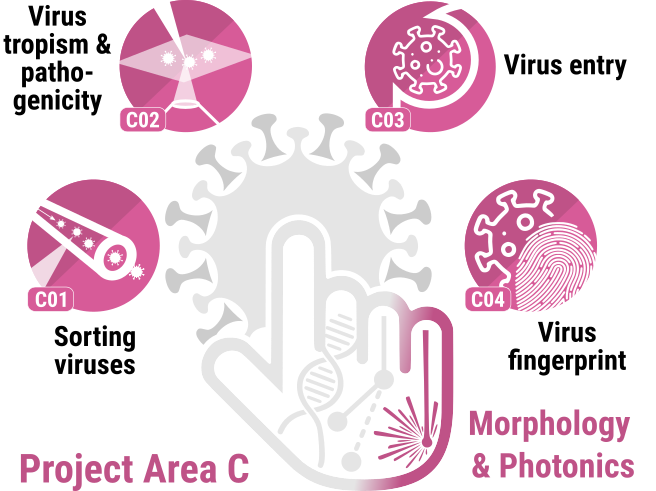
Project Area C
Tools for morphology, entry, and photonic signatures
Project Area C develops photonic and microscopy-based methods to directly visualise viruses and virus–host interactions, enabling the prediction of infectivity, morphology, and cellular responses from image-based data.
Why this matters
Virus morphology, surface structure, and entry mechanisms determine infectivity
Host cells make fate decisions (infection, defence, death) that can be observed optically
Many existing imaging methods are too slow, complex, or low-throughput for real-world virus surveillance
Label-free imaging allows observation of viruses in their natural state
Single-virus and single-cell resolution enables detection of rare but dangerous variants
Direct visualisation links molecular structure to biological function
Why now?
- High demand to directly visualise viruses and their molecular details
- Imaging technologies have reached the nanometre scale needed for virus analysis
- Tools are ready to be advanced toward simplicity and high throughput
- Multimodal and AI-based image analysis now enables fast, information-rich virus characterisation
Methods used
Electron microscopy (EM)
Super-resolution and fluorescence microscopy
Raman spectroscopy
Correlative EM–optical microscopy
Near-field microscopy
Interferometric scattering (iSCAT)
Image-based AI and ImageJ pipelines
Tools and methods to be developed
Fibre-based virus analysis (FaNTA)
Tip-enhanced Raman spectroscopy (TERS)
Atomic force microscopy (AFM)
Multimodal photonic readouts
Virus image databases
AI-guided virus-entry analysis
Label-free and generic labelling workflows
High-resolution and high-throughput optical detection and characterisation of viruses
Pathogenic viruses have a very characteristic morphology, defined by physical factors such as shape, size, and surface topology and rigidity. Therefore, these parameters must be included when classifying viruses with respect to properties determining their pathogenicity, and it is of utmost importance to include this information in diagnostic pipelines. There are tools to determine these properties, such as electron microscopy, which are, however, rather complex and have a rather low throughput. Therefore, there is a gap in current tools to observe the above parameters, and we hypothesise that a fast and straightforward identification of morphological factors is possible and will help to classify viruses and bacteriophages with the aim of linking them to their pathogenic potential and using this for sorting of viruses. In this respect, optical technologies are an important tool, since they allow for non-invasive and rapid characterisation of nanoscale objects. The aim of this project is to employ our recently developed optical Fiberassisted Nanoparticle Tracking Analysis (FaNTA) for the detection and classification of viruses, Fig. C01.2. Here, the structural parameters of virus particles diffusing through a detection spot in an optical fiber or waveguide will be retrieved using measurements of elastic scattering and/or fluorescence emission. In this, the most challenging issues are the distinguishing of different viruses and of unwanted background material, which will be approached through optimisation of the fibers, correlation of readouts, and tailored data analysis. Specifically, we aim to employ a combination of label-free scattering-based detection and generic fluorescence labelling approaches, novel fiber technology, advanced scattering approaches, and fluorescence spectroscopy, and their joint detection and analysis. Analysis specifically includes a tailored interpretation of diffusional tracks, and we will openly share the analysis software. The long-term goal is to apply these methods to sort viruses. With this, we serve multiple research questions of the CRC VirusREvolution as well as the goals of virus description (G1, G3) and prediction of virus infectivity (G4).


Probe microscopy-based functional tracking of respiratory viruses to identify virus tropism
We aim to characterise virus tropism by identifying permissive cell types that support complete virus replication by using Tip-enhanced Raman Spectroscopy (TERS). TERS integrates atomic force microscopy (AFM) and near-field optical recordings with Raman spectroscopy, enabling direct, label-free characterisation of molecular organisation and thus visualisation of virus entry and exit at nanometer resolution. Virus tropism is defined as the selective ability of a virus to infect specific host species, tissues, or cell types. It is determined by virus factors such as receptor binding and replication requirements, as well as by host determinants, including receptor availability and intracellular conditions. As a result, tropism ultimately defines whether productive replication occurs and thereby shapes virus pathogenesis, disease progression, and transmission. However, inferring tropism from virus properties alone remains difficult and typically requires elaborate infection experiments. In this project, TERS will be employed to resolve virus entry and exit strategies with unprecedented spatial detail, Fig. C02.1. Beyond imaging, TERS provides molecular fingerprints and resolves nanoscale surface structures, thereby revealing chemical and conformational changes that accompany virus-cell interactions. Time-resolved nanoscale studies will further allow us to monitor replication at the level of single infection events and to detect heterogeneous infection patterns that are masked in bulk analyses. By combining structural and temporal information, we aim to precisely define the host cell factors and physiological states that permit or restrict virus replication, thus contributing directly to research goals G3 and G4. Our approach represents a novel, rapid, label-free, and phenotypic method to define virus tropism. In addition to TERS, we will employ nanoscale infrared spectroscopy (nanoIR), a technique that combines AFM with IR absorption to provide chemical composition and conformational information at nanometer resolution. The combination of nanoIR and TERS will yield complementary spectroscopic data to unravel structural changes during virus-cell interactions, potentially down to amino acid resolution. To further dissect the influence of host determinants on virus tropism, we will additionally apply a cellular senescence model.
This approach extends our nanoscale analyses by addressing how age-related cellular changes shape virus entry, replication, and release. Preliminary data indicate that virus load in senescent cells differs markedly from controls, thereby linking methodological innovation with a key biological question, as elderly populations are especially vulnerable in pandemics. Together, these technologies will enable dynamic, high-resolution visualisation of virus entry and budding, offering an innovative framework to redefine the study of virus tropism.


Deciphering virus-membrane interactions with advanced optical microscopy and machine learning-supported image analysis
A critical step in virus infection is the initial uptake of viruses into host cells. Interestingly, and perhaps counterintuitively, a particular virus may use different modes of crossing the plasma membrane, either in the same cell or depending on cell type. Even for members of the same virus family, different modes of uptake have been observed. The main uptake pathways include the use of membrane fusion or endocytosis. A number of endocytic mechanisms have been discovered and these depend on multiple factors, such as cell type and surface receptors, as well as cell membrane properties. Importantly, the uptake path usually determines the fate and infectivity of a virus. Thus, predicting the mode of entry is important for choosing and optimising preventative or impeding measures of infections. However, determining an uptake mechanism is challenging due to multiple factors involving assay design and observation technology. An accurate investigation requires an adapted experimental design for each virus, receptor and host cell, analysing binding, uptake, routing, and the infection cycle of cellular and virus proteins. At the same time, direct microscopic imaging of the viruses and other molecules involved in the uptake into living cells should employ as high a temporal and spatial resolution as possible, since every entry mode displays specific spatiotemporal dynamics of virus and molecular movements at the cell and virus surface. Finally, data analysis needs to be tailored to correlate a “microscopic signature” of entry events with fusion signatures and particular endocytic mechanisms, which would then make it possible to identify the mode(s) of entry of an emerging virus. Unfortunately, the realisation of high-resolution microscope experiments of virus uptake is usually too complex to accomplish a straightforward and quick prediction of entry modes of newly emerging viruses. This is, however, within the overall aim of this CRC VirusREvolution, which is to set up tools to quickly react to potential pandemic threats. We therefore propose to realise a fast and facile tool to predict the mode(s) of virus entry from standard low-resolution live-cell microscopy data. To achieve this, we will combine high spatiotemporal resolution microscopy data with methods from Machine Learning (ML) / Artificial Intelligence (AI) for fast, objective, and quantitative analysis to establish a tool that allows correlation with the standard microscopy data of lower spatiotemporal resolution. This shall enable the characterisation and differentiation of the membrane interactions of virtually any virus, using widely used standard and less complex microscopy approaches, such as widefield or confocal microscopy. We will employ a machine learning approach that builds on the experience gained from working with a variety of viruses. Thus, the performance of our tool will gradually improve as more and more virus data becomes available. Our experimental and computational tools will contribute to answering the research questions of the CRC VirusREvolution, such as revealing mechanisms of virus entry and tackling the goals of the description and prediction of the infectivity of viruses and their hosts.


Raman spectroscopy: A tool for host response and virus characterisation
The rapid emergence of zoonotic and human viruses, such as SARS-CoV-2 and IAV H1N1, underscores the urgent need for advanced technologies capable of swiftly identifying molecular markers and phenotypic response patterns of virus-cell interactions. Current diagnostic and analytical approaches often rely on limited molecular data, hindering our understanding of the complex interplay between viruses and their hosts, which is crucial for initial management of virus outbreaks. A critical gap in virus infection diagnostics is the ability to rapidly determine virus tropism and host response. We hypothesise that analysing the biochemical changes and activation levels in host cells provides the fastest route to characterising a virus infection and developing effective host-based classifiers. This project will address this need by using Raman microscopy, which offers a universal platform for cellular analysis due to its broad compatibility with diverse cell types. Its rapid, label-free measurements provide a versatile tool for investigating the changes in a cell’s morphochemical pattern, which controls many key processes during infection. Modern Raman-based analyses leverage machine learning to integrate spectral information within the biological context, revealing biochemical changes that drive phenotypic adaptations during infection – opening new dimensions for rapidly understanding underlying virus tropism. Building on established Raman spectroscopic fingerprinting of bacterial infections, we aim to extend this powerful technique to virus systems, offering rapid, scalable, and reproducible insights essential for pandemic preparedness, early detection of emerging pathogens, and zoonotic disease surveillance. By leveraging advanced Raman spectroscopic workflows combined with machine learning algorithms, the project aims to translate complex spectral data into actionable phenotypic insights. To ensure reproducibility and comparability, we will establish standardised and rigorously validated sample preparation protocols optimised specifically for Raman analysis, providing a robust foundation for elucidating virus infection cycles. Crucially, the tool we develop will systematically integrate Raman spectroscopy data with multiomics datasets (genomic, transcriptomic, proteomic, and metabolomic) for the analysis of virus interactions across different host systems by investigating infections with the eukaryotic virus SARS-CoV-2 and the vibriophage N4.
Our goal is to create a holistic analytical framework that comprehensively maps the molecular and functional dynamics of virus-host interactions, Fig. C04.1. A pivotal component of our approach will be the collaborative integration with Z02 (Barth/Cassman/Gerlach/König-Ries) and NFDI4Microbiota to enrich and expand the virus reference database VirJenDB with high-dimensional, interoperable Raman spectral datasets. The core research question driving this project is: How can Raman spectroscopic data be systematically and effectively combined with genomic, transcriptomic, and metabolomic datasets – either sequentially or simultaneously – to accurately map the molecular dynamics and host response patterns of virus-host interactions, thereby enabling precise predictions of virus pathogenicity and virulence? By addressing this critical question, our project will develop a robust and unified analytical framework leveraging Raman spectroscopy’s powerful non-invasive and high-throughput capabilities to decode the molecular mechanisms underlying virus infections. Ultimately, this will support the development of rapid and targeted diagnostic strategies as well as effective therapeutic interventions.