
Congratulations to Project A01 on their Nature Communications publication
Congratulations to Project A01 on their Nature Communications publication
Groundwater is one of the largest freshwater reservoirs on Earth and hosts vast microbial communities that live without sunlight and with very limited energy. While these microorganisms are known to play an important role in groundwater quality and nutrient cycling, the role of viruses in these hidden ecosystems has remained largely unexplored.
In this study, researchers analyzed an exceptionally large dataset of genetic material from groundwater samples collected at seven wells in the Hainich Critical Zone Exploratory. They discovered more than 250,000 different viruses, the vast majority of which were previously unknown to science. These viruses mainly infect the most abundant groundwater microorganisms, including bacteria and archaea that are central to groundwater ecosystems.
Importantly, the study shows that many of these viruses carry genes that can directly influence how their microbial hosts process carbon, nitrogen, and sulfur—key elements for life. This means viruses are not just passive parasites, but may actively shape microbial metabolism and nutrient cycling in groundwater.
Why is this important?
Groundwater provides drinking water for billions of people worldwide. Understanding how viruses influence microbial communities helps us better predict how groundwater ecosystems respond to environmental change, pollution, and climate stress. This research establishes a crucial baseline for future studies and highlights viruses as previously overlooked but essential players in maintaining groundwater ecosystem functioning.
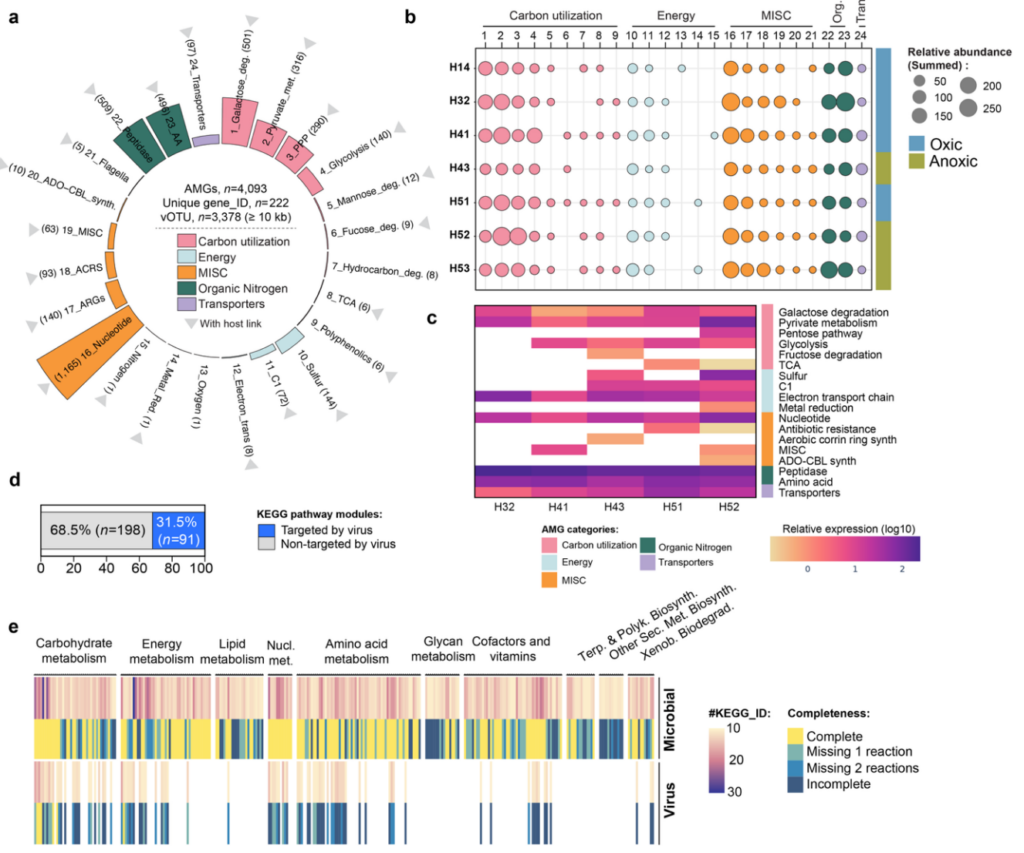
The distribution and metatranscriptomic analyses of the putative auxiliary metabolic genes (AMGs).