

International visibility
Links to national research groups.
At the national level, we expect the CRC VirusREvolution to take a central role in German virus research through the involvement of our personnel in joint initiatives with researchers from other German universities and institutions, see also the list of interactions with the programmes above. With each of the selected scientists from outside Jena (M. Beer (C04), C. Friedel (A02), A. McHardy (B04), D. Kühnert (A02), J. Meiler (B03), S. Reiche (Z03), C. Schoeder (B03), M. Schelhaas (C03), P. Stadler (B02), and F. Weber (A03)) holding leading roles at both national and international levels, their involvement in our CRC ensures our central role in German virus research.
We envision the CRC VirusREvolution serving both nationally and internationally as a platform that bridges the gaps between computational, photonic, and virology research. On a national level, this will involve participants from institutes with broad outreach, such as the German Center for Infection Research (DZIF), German Collection of Microorganisms and Cell Cultures (DSMZ), Hasso Plattner Institute (HPI), federal institutes Friedrich Loeffler Institute (FLI), and Robert Koch Institute (RKI), and Helmholtz Centre for Infection Research (HZI). These very important institutions are eagerly anticipating the tools developed within this CRC, as declared in the support letters received (see Letters of support).
We are linked closely to the national research data infrastructures (NFDIs), to bring our tools into the community and train users for their applications, in line with NFDI’s goals of FAIR data, sustainable infrastructures, and communitydriven research. This is specifically supported by NFDI4Microbiota, NFDI4Immuno, NFDI4Biodiversity, NFDI4Chem, and NFDI4Bioimage.
The CRC VirusREvolution fits perfectly in Jena, due to our strong reputation in bioinformatics and photonics, see Fig. 13. Thus, we expect high-level scientists and students interested in our topics to participate in our CRC VirusREvolution workshops and other activities, such as through our iRTG concept in Z05, our science communication project Z04, and the use of our developed infrastructure from Z02. The CRC VirusREvolution will make computational virus research visible, and not only as a supportive side discipline, in Germany. It will spark interest among a new generation of researchers, drawing them towards the exciting intersection of bioinformatics and other disciplines.
International impact and policy influence.
The technologies and tools developed within our CRC will be distributed through the EVBC, which we founded and which has become one of the largest, if not the largest, international networks dedicated to virus bioinformatics. This centre’s reach extends globally and includes advanced imaging and image analysis methods, facilitating their application in both virology research and clinical settings worldwide. We actively aim for our CRC’s outputs to be integrated into key international databases and resources such as BV-BRC, ViPR, ViralZone, ICTV, Rfam, and NCBI, as well as in collaboration with major research institutions and organisations, and the EMBL-EBI. International visibility is also strengthened by the broad expertise and engagement of our PIs. Their contributions to leading initiatives and consortia ensure that our work is represented and recognised within the global research community. For example, F. Weber (A03) is a member of the WHO Collaborative Open Research Consortium (CORC) on Bunyaviruses, which develops R&D roadmaps for emerging pathogens such as Oropouche virus and Rift Valley fever virus. In addition, F. Weber (A03) participates in the EU-funded HORIZON-RIA project CCHFVACIM (coordinator Ali Mirazimi, Karolinska Institute, Stockholm), which is establishing a One-Health platform to address medical countermeasures, including mRNA vaccines, therapeutic antibodies, and therapeutic mRNAs against Crimean-Congo hemorrhagic fever.
Through these efforts, we not only enhance the global accessibility and usability of our research outputs but also foster stronger synergies with international research teams.
The developed photonic tools will strengthen the capabilities of the Microverse Imaging Centre Jena and with that the research of the Jena Cluster of Excellence “Balance of the Microverse”. Further, the imaging centre is part of the German Bioimaging Initiative and will, in this way, create nationwide visibility of the photonic tools. In addition, the photonic tools will be extremely helpful for the activities of the Leibniz Center for Photonic in Infection Research, where tools can be pushed towards industrial applications. Further national and international research initiatives, where the developed tools will create impact and visibility, are the Leibniz ScienceCampus InfectoOptics and the InfectoGnostics Research Campus Jena, where advanced optical tools are developed and applied to diagnose and combat infectious diseases; the Center for Translational Medicine (CeTraMed) in Jena, where biophotonic methods are used to elucidate the mechanisms of age-associated diseases in order to develop new forms of diagnosis and therapy; the Center for Biophotonic Technology and Artificial Intelligence (CeBAI) at the University at Albany, State University of New York, where within the transatlantic cooperation with the Leibniz-IPHT, photonic technologies and artificial intelligence (AI) are connected to develop innovative solutions for medicine and forensics and to accelerate their path to market; and the Jena-wide European project PHORTIFY, where training programmes in photonics are established to attract young talent to research and industry.
By embedding our bioinformatics and photonic technologies within leading national and international networks, and by fostering close collaborations with global partners, our CRC ensures that its outputs achieve long-lasting visibility, strengthen synergies across disciplines, and maximise scientific and societal impact worldwide.
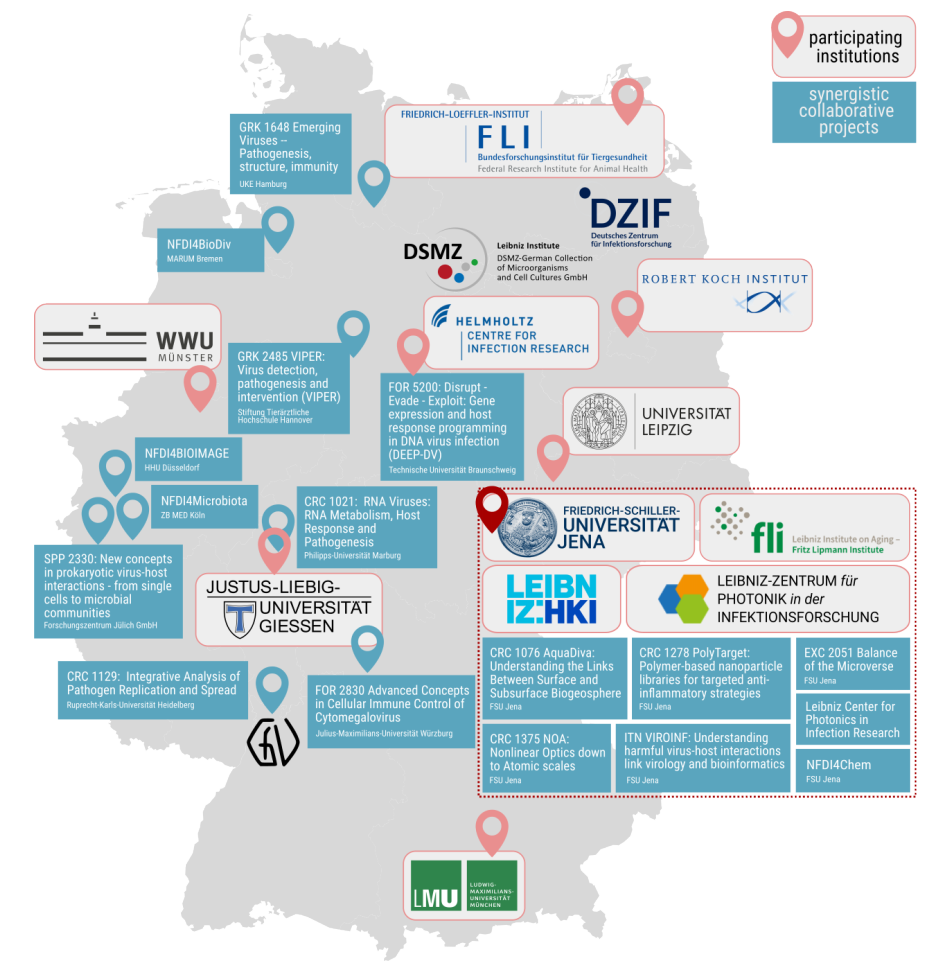
Map of the CRC VirusREvolution network with connections to the national research community, with synergistic effects. Substantial links to the NFDI consortia, especially NFDI4Microbiota, NFDI4Biodiversity, NFDI4Bioimage, and NFDI4Chem are established. Further interactions within Jena can be viewed.
International collaborations.
During the course of the CRC, we actively aim to establish and strengthen several national and international collaborations. These partnerships have led and will lead to more joint publications in high-impact journals together with our collaborators, including, for instance:
- Prof. Dr. Volker Thiel, University of Bern, Switzerland – tools applied to coronaviruses.
- Prof. Dr. Philippe Le Mercier, SIB Swiss Institute of Bioinformatics – integration into VirusZone.
- Prof. Dr. Nicola Zamboni, Clinical Metabolomics Analysis Center, ETH Zürich – integration of metabolomics data in Swiss Multi‑Omics Center (SMOC).
- Prof. Dr. Pieter Dorrestein, UC San Diego – new mass spectrometry-based methods to understand the chemistry of microbes.
- Prof. Dr. Lia van der Hoek, Amsterdam University Medical Center – virus-discovery technique to identify any RNA and DNA virus (VIDISCA).
- Prof. Dr. Florian Krammer, Infection Medicine, Medical University of Vienna – characterising virus pathogens and developing vaccines and therapies.
- Prof. Dr. Delphine Muriaux, University of Montpellier – virus-like particles for photonic research.
- Prof. Dr. Andrey Klymchenko, University of Strasbourg – fluorescent labels for viruses.
- Prof. Dr. Ali Mirazimi, Department of Laboratory Medicine, Karolinska Institute Stockholm – viral zoonosis, virushost interaction, diagnostics, vaccine and antivirus development.
International conferences and events.
Our already established annual conference International Virus Bioinformatics Meeting (ViBioM), monthly viruses in silico lecture series, and monthly seminar meetings are of high interest for other research groups and national institutes within and beyond Germany. The monthly ECR Viromics Webinar Series – jointly hosted by our EVBC, the Center of Microbiome Science at Ohio State University, and the NSF EMERGE Biology Integration Institute – is aimed at for early career researchers studying viruses in complex communities. This platform provides presentations and discussions of novel research, as well as opportunities to make connections.
Media and outreach.
At the CRC VirusREvolution, outreach is a core priority – an essential part of how we communicate our research and its relevance to scientists and society. We place strong emphasis on strategic, focused engagement through targeted media, including a blog, podcast, social media channels, and clearly designed fact sheets, see Z04 (Fabisch/Marz). These tools are not only meant to raise the CRC’s visibility nationally and internationally, but also to foster informed public understanding of virology, bioinformatics, and photonics. By offering accessible, high-quality content in multiple formats, we aim to bridge the gap between science and society, spark curiosity, and support a better understanding of the scientific process – particularly in the context of large-scale, interdisciplinary research efforts.
Emerging international institutes.
Recently, several institutes focused on pathogen detection, surveillance, and intervention have emerged. These include, for example, the LERCO institute, which is currently being founded , and the Centre for Pathogen Bioinformatics, which also focuses on viruses and is in the process of selecting its director . We naturally monitor these developments and establish corresponding collaborations. Networking with key international institutes will be a central focus of our work.