Z01: Central Tasks of the Collaborative Research Centre

Projects of the CRC 1768

Z01: Central Tasks of the Collaborative Research Centre
Central activities of the CRC VirusREvolution
Central tasks. The tasks in the central project Z01 of the CRC VirusREvolution are (1) the management of the CRC with regard to governance, project funds, reporting, staff, travel, and guest scientists; (2) the close collaboration with the other Z-projects Z02, Z03, Z04, and Z05, to support data management and synergy, international visibility and science communication, and the promotion of early career researchers, respectively; (3) the implementation of measures to promote equal opportunities, diversity, and sustainability; (4) the representation and communication of the CRC towards the DFG, partner institutions, and FSU Jena; and (5) the organisation of the scientific VirusREvolution events, such as meetings, symposia, retreats, and workshops, to foster internal communication and strong interactions.
Governance of CRC VirusREvolution. The governance of the CRC is formed by a managing board, Fig. Z01.1, comprising the spokesperson M. Marz (A04) and the four co-spokespersons, of which F. Weber (A03), S. Böcker (B01), and C. Eggeling (C01, C03) represent the three focal areas, and S. Deinhardt-Emmer (C02) our main local virologist and Gender Equality Officer. The board meets twice a year to evaluate the project progress and to plan scientific meetings. It is responsible for devising and implementing measures to promote the CRC towards its scientific objectives.
A scientific coordinator and an administrative assistant (10 h/week) will support the managing board and the central project Z01 with the administrative coordination and organisation of the general tasks (1) to (4). Additionally, the scientific coordinator will take on task (5), which is central to our CRC’s uniquely designed tandem-PI project structure and its three-layer concept described in Research strategy and structure of the CRC.
The CRC will establish an external Scientific Advisory Board (SAB) that will convene once per year at the annual retreat or bi-annually. The SAB will support the CRC managing board with strategic decisions, quality control, and adjustments towards novel developments within the field. Two outstanding candidates have already been secured for the SAB: Robert Edwards (Flinders University, Australia) and Lia van der Hoek (Amsterdam UMC, the Netherlands).
Internal communication and synergy. The heart of our CRC VirusREvolution is its three-layer communication structure, which makes our CRC unique, see Research strategy and structure of the CRC.
By connecting researchers (a) within tandem projects, (b) across the three project areas, and especially (c) our meetings around the overarching research questions defined on p. 37 to create a dynamic environment where ideas are expected to flow freely, expertise is integrated, and innovation is sparked.
Organising these meetings requires substantial effort from the scientific coordinator, who ensures that diverse methodological perspectives and research priorities are brought together effectively. These interactions serve as essential platforms for sharing progress, generating creative solutions to laboratory hypotheses, identifying new applications for our tools, and maintaining consistency in data interpretation and methodologies. Our targeted workshops are dedicated sessions that focus on one single, well-defined research question, see p. 37 and further strengthen collaboration by addressing shared challenges and stimulating novel approaches. This vibrant, structured internal communication is a cornerstone of our CRC and a key driver for achieving its long-term scientific ambitions. These interactions will make our CRC VirusREvolution truely special.
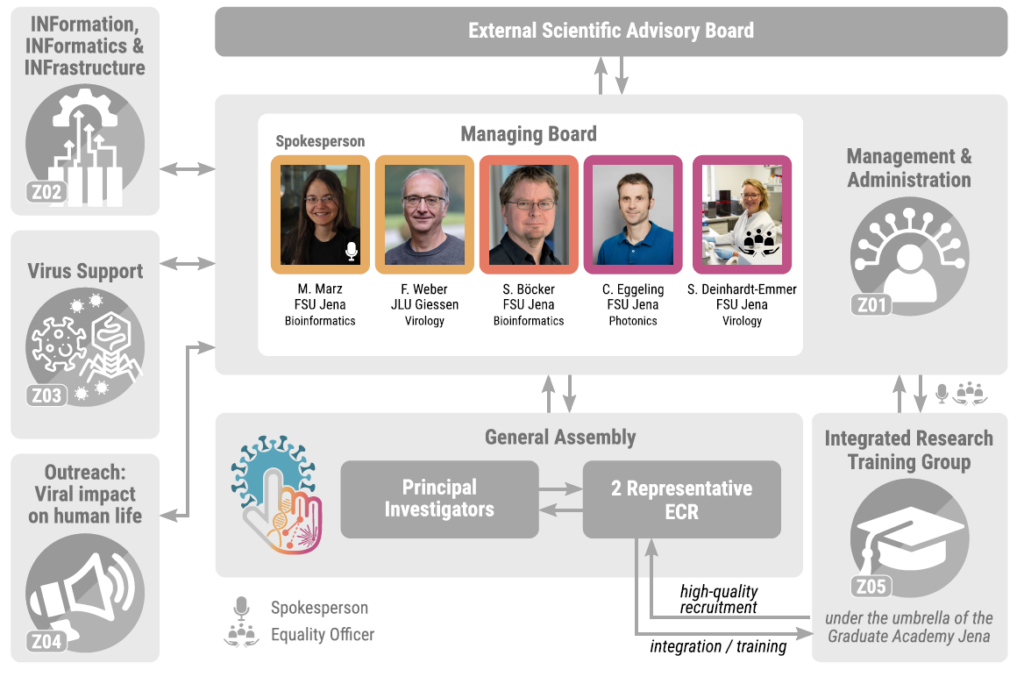
The internal structure of the CRC VirusREvolution.
Measures for data management and collaboration with Z02. The central project Z01 will support Z02 (Barth/ Cassman/Gerlach/König-Ries) with the dissemination of the CRC data management strategy, starting with the onboarding processes and the Welcome Week organised by the IRTG (Z05), and continuing through regular metadata and data modelling workshops, where possible combining with other CRC events. At these workshops, the responsible data person of each project and the Z02 data management team will exchange in order to harmonise the research outputs of CRC VirusREvolution.
Measures for virus support and collaboration with Z03. The central project Z01 will work closely with the virus support project to ensure standardised and harmonised distribution of virus materials across CRC VirusREvolution. This includes coordinating the planning of infection experiments to guarantee comparability between projects, and supporting metadata collection to enable integration with the data management structures of Z02. Regular workshops and exchange meetings will be organised, connecting project PIs, experimental scientists, and the virus support team, to discuss best practices for virus handling, experimental design, and data annotation. This collaboration ensures that infection experiments are reproducible, that data are harmonised across all CRC projects, and that outputs can be seamlessly integrated into the central data management framework, supporting robust crossproject analyses and reliable interpretation of results.
Measures for science communication and collaboration with Z04. The interest in virological topics dramatically increased with the onset of the coronavirus pandemic. The CRC VirusREvolution commits itself to a dissemination strategy that not only aims for visibility within the international scientific community but for sharing of research ideas, aims, and results to the broader public. For this reason we integrate Z04 (Fabisch/Marz), p. 319. Key measures of Z04 include a blog and a podcast to provide education to the lay public about viruses and prepare them for future challenges. We will establish a VirusREvolution internet presence, including a website and social media, to disseminate scientific concepts and progress. Additional key measures include public talks, for example in the wellattended ’viruses in silico’ lecture series of the EVBC, as well as bioinformatics, photonics, and virology talks by CRC PIs in secondary schools to inspire the younger audience toward the natural sciences.
Measures for early career researchers and collaboration with Z05. The CRC VirusREvolution will actively support young scientists at all levels of their career development in due consideration of possible different needs and conditions. In addition to measures taken by the Integrated Research Training Group VirusREvolution (see Z05) for students, doctoral researchers, and postdoctoral researchers, i.e., education, training, and scientific networking, the CRC VirusREvolution will further catalyse career development by establishing and supporting two young research groups: The recently established junior research group ’Innate Immune Signalling Pharmacology’ led by P. Jordan (B02) will continue to receive funding from the FSU Jena. Additionally, upon the CRC funding approval, a junior research group leader position fully financed by the FSU with a research topic on ’ML Data Integration from Photonics to Genomics’ will be newly established and integrated into CRC VirusREvolution, see Junior Research Group “ML data integration from photonics to genomics”.