
C02: Probe microscopy-based functional tracking of respiratory viruses to identify virus tropism

Projects of the CRC 1768

C02: Probe microscopy-based functional tracking of respiratory viruses to identify virus tropism
We aim to characterise virus tropism by identifying permissivecelltypesthatsupportcompletevirusrepli cation by using Tip-enhanced Raman Spectroscopy (TERS). TERS integrates atomic force microscopy (AFM) and near-field optical recordings with Raman spectroscopy, enabling direct, label-free characterisa tion of molecular organisation and thus visualisation of virus entry and exit at nanometer resolution.
Virus tropism is defined as the selective ability of a virus to infect specific host species, tissues, or cell types. It is determined by virus factors such as receptor binding and replication requirements, as well as by host determinants, including receptor availability and intracellular conditions.
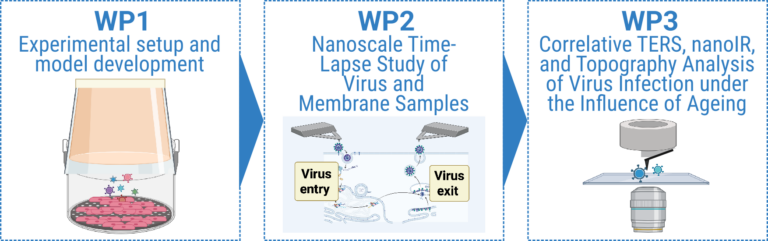
Graphical overview of the three work packages: WP1: Experimental setup and model development. WP2: Nanoscale time-lapse study of virus and membrane samples, analysis of virus entry and exit. WP3: Correlative TERS, nanoIR, and AFM topography analysis of virus infection under the influence of ageing.
As a result, tropism ultimately defines whether productive replication occurs and thereby shapes virus pathogenesis, disease progression, and transmission. However, inferring tropism from virus properties alone remains difficult and typically requires elaborate infection experiments.
In this project, TERS will be employed to resolve virus entry and exit strategies with unprecedented spatial detail, Fig. C02.1. Beyondimaging, TERSprovidesmolecularfingerprintsandresolvesnanoscalesurfacestructures, thereby revealing chemical and conformational changes that accompany virus-cell interactions. Time-resolved nanoscale studies will further allow us to monitor replication at the level of single infection events and to detect heterogeneous infection patterns that are masked in bulk analyses. By combining structural and temporal information, we aim to precisely definethehostcellfactorsandphysiologicalstatesthatpermitorrestrictvirus replication, thus contributing directly to research goals G3 and G4. Our approach represents a novel, rapid, label-free, and phenotypic method to define virus tropism. In addition to TERS, we will employ nanoscale infrared spectroscopy (nanoIR), a technique that combines AFM with IR absorption to provide chemical composition and conformational information at nanometer resolution. The combination of nanoIR and TERS will yield complementary spectroscopic data to unravel structural changes during virus-cell interactions, potentially down to amino acid resolution. To further dissect the influence of host determinants on virus tropism, we will additionally apply a cellular senescence model.
This approach extends our nanoscale analyses by addressing how age-related cellular changes shape virus entry, replication, and release. Preliminary data indicate that virus load in senescent cells differs markedly from controls, thereby linking methodological innovation with a key biological question, as elderly populations are especially vulnerable in pandemics. Together, these technologies will enable dynamic, high-resolution visualisation of virus entry and budding, offering an innovative framework to redefine the study of virus tropism.
Project Overview
Understanding the determinants of virus tropism is essential for assessing the pathogenic potential of emerging respiratory viruses. While receptor expression is a key factor, it has become increasingly clear that successful virus replication depends on a complex interplay of host cell properties, including tissue-specific co-factors, immune signalling, and structural integrity. These factors are further influenced by host age, which alters the cellular environment and can affect both susceptibility to infection and virus evolution.
This project aims to dissect the molecular, biophysical, and age-dependent mechanisms that govern respiratory virus tropism, using SARS-CoV-2 as a model system. By integrating cutting-edge nanospectroscopic methods (AFM, TERS, nanoIR) with physiologically relevant human cell models, we will investigate virus entry, replication, and adaptation in unprecedented detail. Our approach will enable a multi-scale understanding of how viruses interact with the host and how ageing shapes these interactions, ultimately contributing to more accurate risk assessments and improved antiviral strategies, Fig. C02.1. This project relies on the unique synergy between the Deinhardt-Emmer lab, which conducts all BSL-3 infection and cell characterisation work, and the Deckert lab, which applies all photonic approaches, with all steps necessarily carried out in close coordination
Objectives
a. Objective1: Developmentofavirus-compatiblehigh-resolutioninfectionmodel.
Amajorchallengeinstudying virus tropism andreplication is the lack of experimental platforms that combine high spatial resolution with biological safety and physiological relevance. To address this, we will establish an advanced in vitro system that integrates AFM and TERS within a bio-safe environment. This will allow molecular resolved imaging and spectroscopic analysis of virus-cell interactions in real time, without compromising experimental integrity.
b. Objective 2: Nanoscale visualisation of virus entry and budding dynamics.
Understanding the physical mechanisms of SARS-CoV-2 entry (e.g. membrane fusion) and exit (budding) is critical to define the determinants of virus tropism and replication efficiency. Using fast-scanning AFM, in correlation with nanomechanical mapping, nano-rheology, and simultaneous TERS analysis, we will directly observe and quantify these dynamic events at the single-virus and naturally single-cell level. The capability to observe entry on a single virus level will potentially also allow for direct correlation of virus structure and nanomechanical properties with the entry process. In this way, subspecies can be identified simultaneously via function and structure.
To understand how viruses exploit or alter host cell structures during infection, we will use TERS and nanoIR to map both surface and subsurface structural changes in infected epithelial cells. By combining this with transcriptomic and metabolomic profiling, we can link virus-induced structural alterations to functional consequences in the host.
c. Objective 3: Investigating the impact of ageing on virus tropism with anomechanic and nano-spectroscopic tools.
The interplay between virus replication and the structural, metabolic, and transcriptomic state of the host cell is a central determinant of virus tropism. Ageing alters the host tissue environment in ways that may enhance susceptibility to virus infection. In aged tissues, these cellular states are profoundly altered and potentially reshape virus-host interactions. We will use the full strength of our nanoscale toolbox to investigate the nano rheology and molecular consequences that modulates virus tropism during ageing.
- Tool to be developed: A method to investigate single virus-membrane interactions, combining atomic force microscopy and(Raman)spectroscopy. Thesestructurally sensitive nanoscale spectroscopy techniques, particularly Raman and infrared, will lead to a fast and label-free photonic tool to identify tropism.
Hypothesis enabled by the proposed tool: We hypothesise that age-related changes in the host tissue microenvi ronment act as selective pressures that drive adaptive shifts in virus tropism, ultimately altering virus replication dynamics, tissue specificity, and pathogenic potential.
Overarching CRC goals: Our project C02 leverages AFM-TERS and complementary nanoIR to track single-virus entry, replication, and budding with nanometer, time-resolved molecular fingerprints, defining host-cell determinants and physiological states that permit productive replication and deriving generalisable rules of tropism across contexts (G1, G3). Integrating senescence models and phenotypic spectra enables predictive assessment of tissue/cell-type permissivity, and infection potential, supporting tropism forecasting in aged versus non-aged environments (G4).
Work Packages (WP):
- WP 1: Experimental setup and model development (Deckert/Deinhardt-Emmer)
- WP 2: Nanoscale time-lapse study of virus and membrane samples (Deckert/Deinhardt-Emmer)
- WP 3: Correlative TERS, nanoIR, and topography analysis of virus infection (Deckert/Deinhardt-Emmer)
Team Members



2025
Hornung, Franziska; SureshKumar, Harini K; Klement, Laura; Reisser, Yasmina; Wernike, Christoph; Nischang, Vivien; Jordan, Paul M; Werz, Oliver; Hoffmann, Carsten; Löffler, Bettina; others,
High-fat diet impairs microbial metabolite production and aggravates influenza A infection Journal Article
In: Cell Communication and Signaling, vol. 23, no. 1, pp. 359, 2025.
@article{hornung2025highb,

title = {High-fat diet impairs microbial metabolite production and aggravates influenza A infection},

author = {Franziska Hornung and Harini K SureshKumar and Laura Klement and Yasmina Reisser and Christoph Wernike and Vivien Nischang and Paul M Jordan and Oliver Werz and Carsten Hoffmann and Bettina Löffler and others},

year  = {2025},

date = {2025-01-01},

urldate = {2025-01-01},

journal = {Cell Communication and Signaling},

volume = {23},

number = {1},

pages = {359},

publisher = {Springer},

keywords = {},

pubstate = {published},

tppubtype = {article}

}
Deinhardt-Emmer, Stefanie; Chousterman, Benjamin G; Schefold, Joerg C; Flohé, Stefanie B; Skirecki, Tomasz; Kox, Matthijs; Winkler, Martin S; Cossarizza, Andrea; Wiersinga, W Joost; Poll, Tom; others,
Sepsis in patients who are immunocompromised: diagnostic challenges and future therapies Journal Article
In: The Lancet Respiratory Medicine, vol. 13, no. 7, pp. 623–637, 2025.
@article{deinhardt2025sepsis,

title = {Sepsis in patients who are immunocompromised: diagnostic challenges and future therapies},

author = {Stefanie Deinhardt-Emmer and Benjamin G Chousterman and Joerg C Schefold and Stefanie B Flohé and Tomasz Skirecki and Matthijs Kox and Martin S Winkler and Andrea Cossarizza and W Joost Wiersinga and Tom Poll and others},

year  = {2025},

date = {2025-01-01},

urldate = {2025-01-01},

journal = {The Lancet Respiratory Medicine},

volume = {13},

number = {7},

pages = {623–637},

publisher = {Elsevier},

keywords = {},

pubstate = {published},

tppubtype = {article}

}
Höppener, Christiane; Sobotta, Fabian H; Hoeppener, Stephanie; Deckert, Volker; Brendel, Johannes C
Unraveling the Hierarchical Self-Assembly of Amphiphilic Block Copolymer-Peptide Conjugates by Tip-Enhanced Raman Spectroscopy Journal Article
In: Small, pp. 2502157, 2025.
@article{hoppener2025unraveling,

title = {Unraveling the Hierarchical Self-Assembly of Amphiphilic Block Copolymer-Peptide Conjugates by Tip-Enhanced Raman Spectroscopy},

author = {Christiane Höppener and Fabian H Sobotta and Stephanie Hoeppener and Volker Deckert and Johannes C Brendel},

year  = {2025},

date = {2025-01-01},

urldate = {2025-01-01},

journal = {Small},

pages = {2502157},

publisher = {Wiley Online Library},

keywords = {},

pubstate = {published},

tppubtype = {article}

}
2024
Höppener, Christiane; Aizpurua, Javier; Chen, Huan; Gräfe, Stefanie; Jorio, Ado; Kupfer, Stephan; Zhang, Zhenglong; Deckert, Volker
Tip-enhanced Raman scattering Journal Article
In: Nature Reviews Methods Primers, vol. 4, no. 1, pp. 47, 2024.
@article{hoppener2024tip,

title = {Tip-enhanced Raman scattering},

author = {Christiane Höppener and Javier Aizpurua and Huan Chen and Stefanie Gräfe and Ado Jorio and Stephan Kupfer and Zhenglong Zhang and Volker Deckert},

year  = {2024},

date = {2024-01-01},

urldate = {2024-01-01},

journal = {Nature Reviews Methods Primers},

volume = {4},

number = {1},

pages = {47},

publisher = {Nature Publishing Group UK London},

keywords = {},

pubstate = {published},

tppubtype = {article}

}
2023
Schulz, Luise; Hornung, Franziska; Häder, Antje; Radosa, Lukáš; Brakhage, Axel A; Löffler, Bettina; Deinhardt-Emmer, Stefanie
Influenza virus-induced paracrine cellular senescence of the lung contributes to enhanced viral load Journal Article
In: Aging and disease, vol. 14, no. 4, pp. 1331, 2023.
@article{schulz2023influenza,

title = {Influenza virus-induced paracrine cellular senescence of the lung contributes to enhanced viral load},

author = {Luise Schulz and Franziska Hornung and Antje Häder and Lukáš Radosa and Axel A Brakhage and Bettina Löffler and Stefanie Deinhardt-Emmer},

year  = {2023},

date = {2023-01-01},

urldate = {2023-01-01},

journal = {Aging and disease},

volume = {14},

number = {4},

pages = {1331},

keywords = {},

pubstate = {published},

tppubtype = {article}

}
Deckert-Gaudig, Tanja; Yao, Xiaobin; Darussalam, Erwan; Hornung, Franziska; Carravilla, Pablo; Zhao, Ziliang; Rezaei, Kourosh; Eggeling, Christian; Deinhardt-Emmer, Stefanie; Deckert, Volker
Identification of RNA-containing virus particles using a triple correlative morphological and microscopic approach Journal Article
In: 2023.
@article{deckert2023identification,

title = {Identification of RNA-containing virus particles using a triple correlative morphological and microscopic approach},

author = {Tanja Deckert-Gaudig and Xiaobin Yao and Erwan Darussalam and Franziska Hornung and Pablo Carravilla and Ziliang Zhao and Kourosh Rezaei and Christian Eggeling and Stefanie Deinhardt-Emmer and Volker Deckert},

year  = {2023},

date = {2023-01-01},

urldate = {2023-01-01},

keywords = {},

pubstate = {published},

tppubtype = {article}

}
Höppener, Christiane; Elter, Johanna K; Schacher, Felix H; Deckert, Volker
Inside block copolymer micelles—tracing interfacial influences on crosslinking efficiency in nanoscale confined spaces Journal Article
In: Small, vol. 19, no. 20, pp. 2206451, 2023.
@article{hoppener2023inside,

title = {Inside block copolymer micelles—tracing interfacial influences on crosslinking efficiency in nanoscale confined spaces},

author = {Christiane Höppener and Johanna K Elter and Felix H Schacher and Volker Deckert},

year  = {2023},

date = {2023-01-01},

urldate = {2023-01-01},

journal = {Small},

volume = {19},

number = {20},

pages = {2206451},

publisher = {Wiley Online Library},

keywords = {},

pubstate = {published},

tppubtype = {article}

}
2021
Deinhardt-Emmer, Stefanie; Wittschieber, Daniel; Sanft, Juliane; Kleemann, Sandra; Elschner, Stefan; Haupt, Karoline Frieda; Vau, Vanessa; Häring, Clio; Rödel, Jürgen; Henke, Andreas; others,
Early postmortem mapping of SARS-CoV-2 RNA in patients with COVID-19 and the correlation with tissue damage Journal Article
In: Elife, vol. 10, pp. e60361, 2021.
@article{deinhardt2021early,

title = {Early postmortem mapping of SARS-CoV-2 RNA in patients with COVID-19 and the correlation with tissue damage},

author = {Stefanie Deinhardt-Emmer and Daniel Wittschieber and Juliane Sanft and Sandra Kleemann and Stefan Elschner and Karoline Frieda Haupt and Vanessa Vau and Clio Häring and Jürgen Rödel and Andreas Henke and others},

year  = {2021},

date = {2021-01-01},

urldate = {2021-01-01},

journal = {Elife},

volume = {10},

pages = {e60361},

publisher = {eLife Sciences Publications, Ltd},

keywords = {},

pubstate = {published},

tppubtype = {article}

}
2020
Deckert, Volker; Deckert-Gaudig, Tanja; Cialla-May, Dana; Popp, Jürgen; Zell, Roland; Deinhard-Emmer, Stefanie; Sokolov, Alexei V; Yi, Zhenhuan; Scully, Marlan O
Laser spectroscopic technique for direct identification of a single virus I: FASTER CARS Journal Article
In: Proceedings of the National Academy of Sciences, vol. 117, no. 45, pp. 27820–27824, 2020.
@article{deckert2020laser,

title = {Laser spectroscopic technique for direct identification of a single virus I: FASTER CARS},

author = {Volker Deckert and Tanja Deckert-Gaudig and Dana Cialla-May and Jürgen Popp and Roland Zell and Stefanie Deinhard-Emmer and Alexei V Sokolov and Zhenhuan Yi and Marlan O Scully},

year  = {2020},

date = {2020-01-01},

urldate = {2020-01-01},

journal = {Proceedings of the National Academy of Sciences},

volume = {117},

number = {45},

pages = {27820–27824},

publisher = {National Academy of Sciences},

keywords = {},

pubstate = {published},

tppubtype = {article}

}
2015
Olschewski, Konstanze; Kämmer, Evelyn; Stöckel, Stephan; Bocklitz, Thomas; Deckert-Gaudig, Tanja; Zell, Roland; Cialla-May, Dana; Weber, Karina; Deckert, Volker; Popp, Jürgen
A manual and an automatic TERS based virus discrimination Journal Article
In: Nanoscale, vol. 7, no. 10, pp. 4545–4552, 2015.
@article{olschewski2015manual,

title = {A manual and an automatic TERS based virus discrimination},

author = {Konstanze Olschewski and Evelyn Kämmer and Stephan Stöckel and Thomas Bocklitz and Tanja Deckert-Gaudig and Roland Zell and Dana Cialla-May and Karina Weber and Volker Deckert and Jürgen Popp},

year  = {2015},

date = {2015-01-01},

urldate = {2015-01-01},

journal = {Nanoscale},

volume = {7},

number = {10},

pages = {4545–4552},

publisher = {Royal Society of Chemistry},

keywords = {},

pubstate = {published},

tppubtype = {article}

}